Optimal Pacing and Cut Frequency for Instagram Reels
Completion rate, not likes, drives Reel distribution—make every cut count.

Instagram's algorithm ranks Reels for recommended distribution mainly on completion rate, not on raw like counts or follower volume. That single fact changes what editing is for: every cut, pause, and caption becomes a decision that either keeps a viewer watching or gives them a reason to swipe away.
Why the algorithm scores completion rate above every other signal
Distribution on Instagram runs through two systems, one after the other. The first is the seed audience: a mix of existing followers plus a small group of non-followers whose interests match the content. The second is the recommended-content system, which covers Explore, the Reels tab, and the feeds of people who don't follow the account. Growth happens in that second system, and getting into it depends entirely on how the Reel performs with the first group.
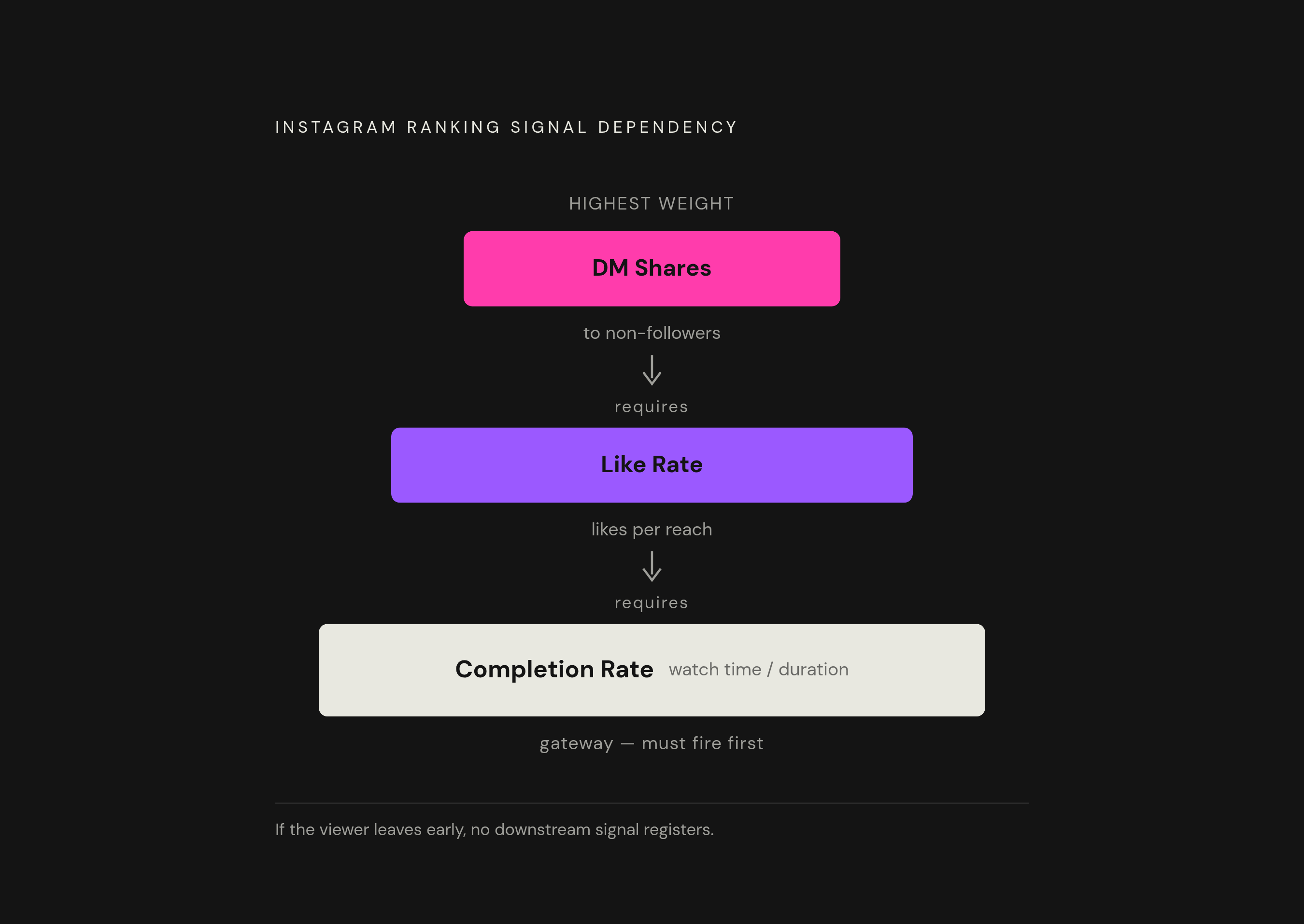
BlitzCut's 2026 algorithm guide confirms the three signals Adam Mosseri identified: watch time and completion rate, likes per reach, and DM shares to non-followers, in that hierarchy of per-action weight. DM shares carry the most weight because they require deliberate intent. Someone watched the Reel, thought of a specific person, and sent it to them, and Instagram reads that as real evidence the content has value. Like rate is likes divided by reach, so a Reel with a high rate from a small audience will outperform one with more total likes spread across a much bigger reach.
All three signals share a dependency. None of them can register if the viewer leaves early. That makes completion rate the gateway metric, and it puts editing decisions, specifically the ones that add seconds of watch time per viewer, upstream of everything else the algorithm measures.
How Silence and Dead Air Function as Drop-Off Triggers
A pause that runs even half a second too long gives a viewer the exact beat they need to swipe away, and the algorithm logs that exit as a mark against the Reel's completion score. Silence removal sits first in BlitzCut's recommended editing workflow for that reason: cutting dead air raises completion rate before any other creative choice gets made.
Dead air is an active invitation to scroll, and each viewer who takes that exit drags down the completion rate that decides whether the Reel ever reaches the recommended-content system. That means pacing starts in the audio track, not on the visual cut timeline. A Reel can be stacked with fast visual cuts and still lose viewers steadily if the pauses between sentences in the voiceover or dialogue are left untouched.
This reframes what an editor is actually doing. The job is tuning a signal the algorithm is going to measure in seconds and fractions of seconds, long before anyone judges whether the content was good.
The specific cut frequencies that move completion rate by content type
Once the dead air is gone, the next lever is cut frequency, and it splits by content type rather than following one universal number. OpusClip's retention analysis sets a general baseline: a cut or visual change at a brisk, steady pace keeps energy up without tipping into chaotic editing, and a static shot held too long is the main danger zone for losing a viewer mid-scroll. Zebracat.ai's 2026 Instagram Reels statistics back this up directly: Reels with frequent jump cuts see higher engagement than continuous-shot videos, and continuous-shot Reels with no cuts at all show meaningfully worse retention than Reels built from strategic edits.
For ads specifically, RoasPig's 2026 targets get concrete by length. A 15-second Reel ad should land roughly one cut every one to two seconds. A 30-second ad can run a slightly slower per-second cut rate than that. A 60-second ad needs a high total cut count scaled up to match the extra runtime.
Content type changes the calibration even when the underlying goal stays the same: prevent the scroll-away. Fast-paced entertainment rewards rapid cuts and constant transitions. Educational content needs longer holds so the viewer has time to actually process information before the next cut arrives. The mechanism doesn't change between the two, only the pace.
A "cut" doesn't have to mean a literal splice. Text overlays, zoom transitions, and B-roll inserts all count as visual changes that do the same job a cut does. The real target is sustained visual momentum, not hitting some exact splice count on a stopwatch.
How Reel Length Changes the Completion-Rate Calculation
Length isn't a fixed rule, it's a dial, and where to set it depends on which signal matters more: reach, which favors short runtimes with high completion, or depth signals like saves and shares, which favor something longer. OpusClip's analysis lays out the core tension: a short Reel with a high completion rate can still rack up fewer total seconds watched per viewer than a longer Reel with a lower completion rate, because Instagram's algorithm weighs both numbers at once. Shorter isn't automatically the winning move.
The shortest Reel formats do post the highest average completion rates, according to Zebracat.ai, making them the safest bet for clearing a high completion-rate threshold and getting pulled into recommended distribution. A mid-length Reel tends to drive more saves and shares than an ultra-short one, and those are the signals that tell Instagram the content was worth returning to.
The research brief citing Brandlix (2026) found that Reels in the 30-to-60-second range often generate more saves and shares than shorter formats, even as their raw completion rate drops. That trade-off matters most for educational and evergreen content, where a save is the outcome a creator actually wants. The data holds up at longer lengths too: LoopexDigital's Reels statistics report found that Reels between 60 and 90 seconds get the highest engagement and view rates among longer formats. This runs directly against any blanket claim that shorter always wins.
Instagram has also extended the maximum Reel length, which widens the range of length decisions a creator can make. That doesn't make length targeting less important. It makes it more important, since a wider range means more ways to get the choice wrong. The decision rule stays simple even with more options on the table: pick length based on the primary signal being chased, short for completion rate and reach, 30 to 90 seconds for saves and shares, and set cut density to match whatever length gets chosen.
The first three seconds as a distribution gate separate from the rest of the Reel
The first three seconds of a Reel work as their own filter, separate from everything that happens after. A Reel that loses the viewer in that window never gets the chance to build the completion rate or share signals that drive the rest of its distribution. BlitzCut's algorithm guide describes this as a two-phase test: Instagram checks performance against the existing follower seed first, and a low completion rate in that initial group means the Reel never reaches recommended content at all.
OpusClip identifies a hook window that opens before Instagram even displays the caption overlay; the visual alone has to create a stop-scroll impulse with nothing else to help it. A strong hook drops the viewer straight into the most compelling moment available. A weak hook opens on a slow pan or a long setup, both of which hand the algorithm an easy early-exit signal.
The practitioner metric for this window is Hook Rate: three-second video plays divided by impressions. A strong Hook Rate means the opening visual is doing its job. A weak one means the opening needs to change, full stop on diagnosis, start over on the creative. Hook Rate and cut frequency are two separate levers running in sequence: Hook Rate governs the first three seconds, cut frequency governs everything from the fourth second onward.
One more factor shapes what's allowed to work as a hook. Instagram now runs an Originality Score on every uploaded Reel, and it penalizes recycled content, including TikTok reposts carrying a visible watermark. A watermarked hook gets suppressed before it ever reaches the follower-seed test, so native production, or AI-generated content built from scratch, isn't optional at this stage.
Three named pacing frameworks that apply the cut-frequency logic to specific Reel structures
Cut frequency isn't one setting applied the same way to every Reel. The strongest performers use one of three distinct pacing architectures, matched to what the content is trying to do and how much energy it needs to sustain.
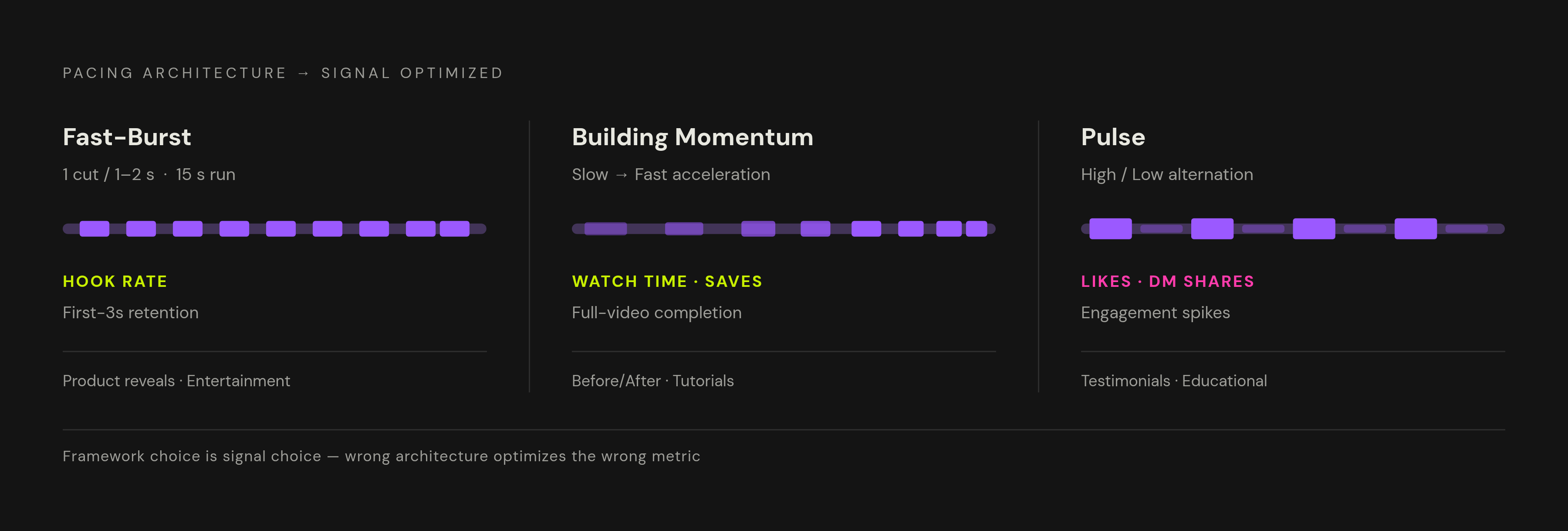
The Fast-Burst Framework, from RoasPig's 2026 guidance, puts a new visual on screen every one to two seconds and packs several key points into a 15-second run, holding high, consistent energy the whole way through. It fits product reveals, trend participation, and entertainment-first content where the goal is immediate impact.
The Building Momentum Framework runs slower cuts early and accelerates toward rapid cuts by the end, building a context-first, payoff-last structure. That suits before/after reveals, tutorials, and story arcs, where the viewer needs the setup before the resolution lands.
The Pulse Framework varies cut frequency on purpose, moving through a high/low/high/low energy pattern rather than holding one speed. It fits testimonials, talking-head videos, and educational content, where sustained high intensity would exhaust the viewer rather than hold them.
For ecommerce Reels specifically, the research brief citing DigitalApplied points to a four-beat structure as the top performer in 2026: a native-style hook at the open, problem-agitation through the early middle, product demonstration or social proof through the later middle, and a direct call-to-action at the close.
Each framework targets a different signal. Fast-Burst is built to move Hook Rate, the production metric for opening-frame performance. Building Momentum is built to move total watch time and saves. Pulse is built to move like rate and DM shares from an engaged, niche audience. Picking a framework means picking which signal the Reel is optimized to move.
Where the "Cut Faster" Prescription Breaks Down
Cutting faster isn't a universal fix, and the data makes that clear in a few specific places. LoopexDigital's 2026 report found that Reels between 60 and 90 seconds get the highest engagement and view rates, contesting the "shorter always wins" logic that sits underneath a lot of generic cut-frequency advice.
Fast cuts and animated captions can actively hurt completion rate on educational and founder-led content when the push for energy costs the viewer clarity. The research brief citing ProdShort (2026) documents cases where simple, steady captions outperformed flashy edits, because the viewer understood the point the first time through. If the editing gets in the way of the message, the viewer won't save it or share it, no matter how high the completion rate ends up.
This connects back to what Mosseri's three confirmed signals actually measure. Watch time, likes per reach, and DM sends are quality signals that track whether the content is genuinely good, not whether it hit a particular cut frequency, and mechanical fast-cutting that reduces comprehension moves none of them positively.
The resolution is to treat cut-frequency targets as a floor, not a ceiling, the minimum pace needed to keep a viewer from scrolling away, not the maximum pace an editor can physically pull off. The right frequency is the slowest pace that still holds the audience. For the kind of attention that actually compounds, saves, DM shares, a high like rate, readability wins over spectacle almost every time.
Captions as a pacing instrument, not an accessibility add-on
Around 20% of Reels are watched without sound, and in that silent environment, captions carry the narrative momentum that cuts alone can't sustain. OpusClip's format analysis treats captions as essential to retention: text overlays do the work of carrying the story when there's no audio playing. Caption timing belongs inside the pacing decision, not bolted on afterward.
There's a specific timing target here too. Each piece of text needs to stay on screen long enough for a viewer to read it comfortably, but short enough that it doesn't slow the Reel down. Done right, a caption functions as a visual cut in its own right. A caption-completion rate, the share of viewers who read a line of text all the way through, reinforces the same watch-time signal the algorithm already tracks, whether or not the viewer has sound on.
Where the caption sits on screen is also a pacing call. Text centered in the middle of the frame pulls the eye away from the visual underneath it. Text placed in the lower third lets the visual keep doing its job while the words still move the story forward. And when captions appear and disappear in sync with the cuts, they build a second rhythm that reinforces the visual pacing. A caption that lingers past its cut breaks both rhythms at once, the text track and the visual track, in the same moment.
AI Video Generation and the Cost of Cut-Frequency Strategy at Scale
Fast-Burst optimizes Hook Rate and early completion, Building Momentum optimizes total watch time and saves, and Pulse optimizes like rate and DM shares from engaged niche audiences, three named pacing frameworks that apply the cut-frequency logic to specific Reel structures. That used to mean hours of manual work per video: trimming dead air frame by frame, timing captions to the exact cut, adjusting pace for a 15-second ad versus a 60-second one. AI-assisted video generation collapses that timeline, applying the same cut-frequency targets and caption timing automatically across a batch of Reels instead of one at a time. That shift doesn't change what the algorithm rewards. It changes how many Reels a creator can produce that actually meet the standard the algorithm is measuring.
Sources
- Ideal Instagram Reels Length & Format for Retention - OpusClip Blog
- 100+ Instagram Reels Statistics for 2026
- Instagram Reels Statistics 2026: Key Stats and What They Mean for Growth
- Instagram Reels Algorithm 2026: The Editing Signals That Drive Reach · Blitzcut
- Instagram Reels Best Practices for 2026: The Complete Guide - Brandlix Blog
- What Pacing Works Best for Instagram Reels Ads?