Hook Structures for AI-Generated TikTok Videos
TikTok's algorithm decides video fate in two seconds, making the hook the first creative choice.
TikTok decides whether a video gets distributed based on completion rate, and completion rate gets decided in the first two seconds. That single fact reorders every other production choice a creator makes. The platform's FYP gate system releases a new video to an initial pool of viewers, and only if completion rate in that small window clears a threshold does the video get pushed to wider audiences. A video that loses viewers in second one never gets the chance to prove itself with better editing, a stronger CTA, or a cleaner cut later on. TikTok's own business guidance backs this up on the paid side too: 90% of ad recall happens within the first six seconds, and the guidance is explicit that value has to show early, a rule that applies to organic posts exactly as much as to ads. The hook decides whether the rest of the video gets watched.
How AI video production shifts the hook from afterthought to first decision
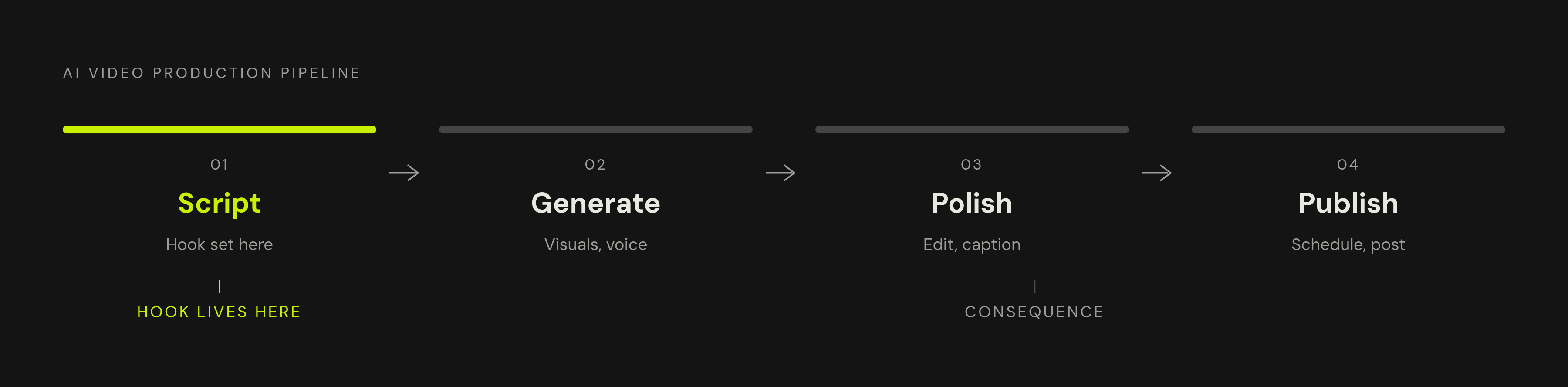
AI tools have compressed the entire production cycle down to minutes, and that compression moves the hook from the last thing a creator polishes to the first decision that gets made. Production used to mean camera setup, recording, editing, captioning, and scheduling, a pipeline where a weak opening line could get fixed in the edit bay over hours of iteration. AI collapses that pipeline into a single stage: the script. Once the script is the product, the hook stops being a line you can patch after the fact, because there's no long edit process left to patch it in. This isn't a niche behavior shift, either. A recent survey found that a large majority of creators already use at least one AI tool somewhere in their production pipeline. The standard 2026 workflow runs in four stages: script, generate, polish, publish. The hook lives in the script stage, so it's the decision that determines the quality of everything generated downstream. Faceless AI content can now be produced at a scale no manual pipeline could match, so the bottleneck isn't how fast a creator can make videos anymore. The bottleneck is creative judgment: what those first three seconds are actually going to say. Platforms built for this moment reflect that shift directly. A unified interface can pull from models including Veo, Kling, Sora, and ElevenLabs inside one workflow, so a hook-first script goes straight into generation without the manual handoffs that used to dilute a creator's original intent.
The five hook structures that consistently outperform
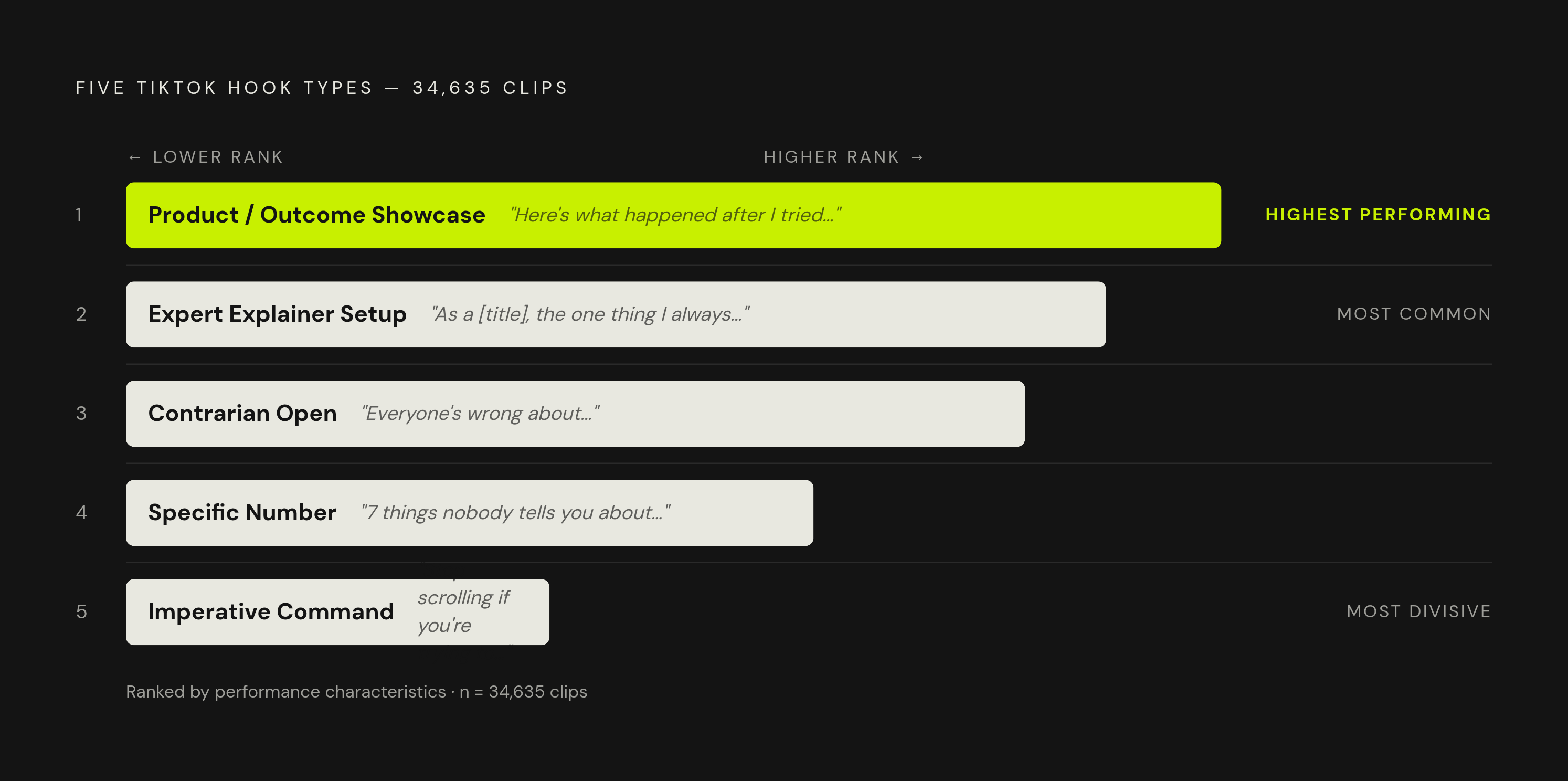
Analysis of 34,635 TikTok clips surfaced five hook types that consistently beat the rest, and each wins by triggering a specific, predictable response rather than through cleverness. Each one works because it triggers a specific, predictable response in a viewer's brain within the first two seconds. Before getting into what works, it's worth naming what doesn't: face-on "Hi everyone, today we're going to talk about" openers, "Okay so..." delay openers, and "Have you ever wondered..." setups all underperform in the data.
The Product / Outcome Showcase is the highest-performing hook type in the dataset. It leads with the result itself, the finished transformation, the before-and-after, the number, so the viewer knows within the opening frame what they're getting if they stay. The mechanism is that it requires zero setup and zero context: the payoff is the opening frame, not something promised three sentences later. Templates include "This AI tool just edited an entire week of TikToks in minutes" and "Before and after using [product] for a month". This hook type fits AI video workflows especially well, because a generated before-and-after clip can function as the hook and the opening visual at the same time.
The Expert Explainer Setup is the single most common structure in the dataset, appearing in the largest share of clips analyzed. It runs on a three-move sequence: an authority signal, a curiosity gap, then a promise of payoff, all landing before the algorithm finishes its first distribution decision. It works because short-form viewers extend trust to short-form experts faster than they extend it to long-form ones, so three seconds of telegraphed expertise does real work. A typical template: "I've worked in [role] for 12 years. Here's the thing nobody tells you about [topic]". In faceless AI content, that authority signal doesn't need a presenter on camera. Text overlay can carry it instead.
The Contrarian Open takes a belief the audience already holds and rejects it in the first sentence. The mechanism is cognitive: a brain presented with a contradiction can't just let it sit unresolved, so the viewer stays to watch it get resolved. A working template is "You've been told [belief]. It's wrong". This one carries a real cost if misused: it only works when the content genuinely backs up the claim it opens with, because a contrarian open followed by weak follow-through teaches an audience to distrust the creator.
The Specific Number works because specificity beats generality, and numbers grab attention involuntarily in a way vague claims don't. An odd, precise number reads as authentic in a way a round number doesn't, because real outcomes tend to produce odd numbers and marketing tends to produce round ones. The number creates a small, specific promise: the viewer wants to know what produced that exact result, and dismissing a specific claim costs more cognitive effort than dismissing a vague one.
The Imperative Command is the most aggressive of the five: "Stop scrolling." "Watch this." "Listen". It breaks the passive scrolling mode by demanding engagement in a medium built around disengagement. It's also the most divisive of the five hook types: when it lands, it lands hard, and when it doesn't, it reads as desperate. Save it for content with genuinely high stakes for a specific viewer. A mild tip dressed up with "stop scrolling" oversells what's coming. A working template is "Stop scrolling if you're trying to [outcome]".
How native TikTok ad hook formats differ from organic hooks
Ad hooks on TikTok follow the same underlying mechanics as organic hooks, completion rate in the first seconds still decides everything, but a brand-voiced opener that reads like an announcement fails the native-feel test before the product ever gets on screen, while a creator-style opener earns the watch the same way an organic post would. TikTok's own creative guidance for ads tells advertisers to introduce the content proposition early, treat the first six seconds as the hook window, use captions or text overlays so the story works without sound, and keep on-screen text moving at a brisk pace. Ads also carry a timing structure: an opening hook, followed by story, demo, or proof, then an objection or comparison, then the call to action, a constraint worth writing directly into an AI script prompt rather than leaving implicit. Four ad-native hook formats borrow TikTok's ordinary creator grammar instead of sounding like a pitch. A comment-led hook opens as if it's replying to a real buyer question, something like "Someone asked if this works on oily skin," which reads as a conversation already underway rather than an ad starting cold. A POV hook drops the viewer into a recognizable situation before the product ever gets named, as in "POV: your client asks for edits at 9 p.m.," leading with identity rather than features. An "I found this" hook borrows the discovery framing native to how people already browse TikTok, and it performs especially well for product finds and low-ticket impulse buys. A plain-speech problem statement sounds like advice rather than a sales pitch, something like "Your landing page isn't the problem. The first offer is," and it works well for services and apps where a hard sell would backfire. One rule governs the opening frame itself: one idea per frame, not a logo, a slogan, a discount, and a product grid competing for attention at once, just the product or the problem shown clearly, a reason to care added in a caption, and a small break in the motion to catch the eye. Symphony Automation and Symphony Agent sit directly inside TikTok Ads Manager, while Symphony Creative Studio runs as its own standalone workspace, generating ad scripts, opening hooks, and video content from brand inputs including brand-voice training, and creators can run it alongside outside AI video tools rather than choosing one over the other. Top-performing brands are already generating large numbers of creative variants every week, treating hook structure itself as the variable under test across demographic sub-segments inside TikTok's Smart+ Campaigns.
Translating hook structures into AI video prompts, from script to generated clip
Each of the five hook types maps onto its own prompt pattern, and writing that prompt as a full production brief, specifying the hook type, the audience, the format constraint, and the curiosity mechanism doing the work, makes the generated output dramatically more usable. A useful scaffold for that prompt is the six-beat script structure: hook in the opening seconds, problem statement, failed attempts, discovery, result, then a soft CTA. An LLM fed the topic and the hook type generates several variations, and the strongest opening line gets picked before a single frame of video gets generated. For contrarian and pattern-interrupt hooks specifically, a template already tested in research looks like this: act as a TikTok creative strategist, generate five pattern-interrupt hooks for a named product or service targeting a named audience, each one challenging a common assumption or revealing a surprising truth. Starting phrases like "Everyone thinks...but," "The real reason...," or "What nobody tells you about..." work well here, and keeping each hook under eight words while making sure it creates an immediate curiosity gap keeps the output usable rather than bloated.
Outcome showcase hooks need the prompt to lead with the visual over the copy. The generated clip of the before-and-after is the hook, so the video prompt and the script's hook line need to describe the same moment. To scale hook variation past one-at-a-time guessing, train the LLM on transcripts from past high-performing videos, which lets it generate a large batch of hook variations quickly, tested together rather than bet on individually. A workflow that accepts text and script input and routes it through Veo, Kling, Sora, and ElevenLabs lets a creator run several hook variations as parallel generation jobs, testing structural types side by side without rebuilding the pipeline for each one.
Model choice matters by hook type. Outcome showcase hooks benefit from visual quality and consistency, which makes Veo 3.1, the stable release as of October 2025, a strong fit for brand content and educational visualization. Multi-scene hooks that need a character to stay consistent across cuts point toward Seedance 2.0, built by TikTok's parent company ByteDance and ranked at the top of the Artificial Analysis Video Arena leaderboard. Physics-demonstration hooks, the kind that rely on believable motion and materials, favor Sora 2 for its world consistency. High-volume hook testing, where visual continuity across clips matters less than sheer output, runs well on Kling 3.0, which comes in at a lower cost per clip.
Using AI analysis tools to audit which hook structures work in your niche
AI video analysis tools can break down the hook structure behind a competitor's high-performing clip in seconds, turning what used to be hours of manual scrubbing into a repeatable step ahead of the next production cycle. These tools can detect what happens in a video's opening seconds, whether it's a face close-up, a text overlay, a surprising visual, or a pattern interrupt, along with editing pattern and cut frequency, on-screen text placement and timing, CTA type and placement, and which audio choices correlate with reach. The output answers a different question than a basic analytics dashboard does. Instead of just reporting how many views a clip got, it connects specific creative elements to the performance outcome, so a creator knows which structural hook pattern actually drove retention.
That turns into a practical loop. Analyze the top-performing clips in a given niche, identify which of the five hook types each one is running, feed that identified structure into a prompt template, generate variants, and test them in batches rather than one video at a time. This loop is what makes AI-assisted production compound instead of reset with every new video: the analysis stage feeds the script stage, the script stage feeds generation, and generation produces the next round of performance data for the next analysis pass. Paid campaigns have a parallel version of the same feedback loop built in. TikTok's Smart+ Campaigns can test different hook angles within one consolidated ad set, letting the platform's own AI surface which structural type resonates with which demographic sub-segment. Organic or paid, the mechanism is the same: hooks get engineered, tested, measured, and refined, and the five structures aren't a fixed list to memorize so much as a starting set of variables to keep running back through that loop.