AI-Generated B-Roll for Short-Form Documentary Style Videos
Technical advances now make AI B-roll reliable enough for documentary storytelling.
AI-generated B-roll was once a novelty act, but now it's a real production discipline. The clips that used to look wrong, subjects morphing mid-shot, lighting that shifted between cuts, transitions that jolted the eye, now hold up because the diffusion and temporal-consistency models underneath them have gotten good enough to trust.
Festival programmers and documentary editors who sat through early AI-assisted cuts noticed the same problem over and over: the footage was technically on-topic but did nothing for the story. Narration would mention a changing business, and the AI would drop in someone typing on a laptop. Narration would mention money, and up came a shot of cash. Every choice was generic. Every choice was interchangeable with every other choice. That's the failure mode that defined the first wave of AI B-roll: clips that matched the keywords in the script but carried no argument of their own.
Diffusion models can hold a subject's face, wardrobe, and surroundings steady across a clip now, so they stop letting them drift. Temporal-consistency techniques also fixed the frame-to-frame flicker, so early output no longer looks like a slideshow trying to be video. Those are technical fixes, but they raised the floor. A clip generated today can hold a scene together for five, eight, ten seconds without falling apart, and that reliability makes a repeatable workflow possible.
The deeper shift is in how creators approach the prompt itself. Early AI B-roll treated the prompt like a vibe check: describe the mood, describe the subject, hope the model fills in the rest. The discipline that's replaced it treats shot type, lighting, mood, camera motion, continuity, and exclusions as separate variables to control on purpose, not details to leave to chance. That's the real dividing line in short-form documentary video now. B-roll generation gets treated either as engineering, with inputs a creator controls and outputs a creator can predict, or as a slot machine a creator pulls and hopes.
B-roll in the documentary style
Documentary-style short-form video asks more of its B-roll than almost any other short-form format does. A lifestyle reel or a product demo can get away with footage that just fills space while someone talks. Documentary format can't. Each clip has to do work: explain an idea, back up a claim, set a mood, show a consequence, or control how fast the piece feels like it's moving, because the footage is argument.
Decorative versus functional B-roll is the distinction to hold onto through the rest of this piece. Decorative B-roll covers the screen while the narrator talks. Functional B-roll gives the viewer something the narration alone can't: a close-up of a warehouse supervisor's face while an autonomous robot reroutes packages behind her tells the viewer something about tension, control, and human reaction that no voiceover line could deliver as efficiently. The shot is doing its own argumentative work, separate from whatever the narrator says over it.
Short-form adds a second pressure on top of that: time. When a video has to hold attention every three to five seconds, a B-roll cut doesn't get a grace period to settle in. It has to land the instant it appears on screen. There's no slow build available in a fifteen-second TikTok the way there might be in a thirty-minute documentary.
This is where stock footage runs out of road. Documentary B-roll needs continuity: the same location, the same subject, the same wardrobe, the same lighting across every cut in a sequence. It needs restrained camera movement, a handheld push-in rather than a sweeping drone shot, since restraint reads as observed while sweeping movement reads as staged. And you need a muted, grounded color palette, because polish reads as produced, not captured. Stock libraries can't deliver any of that reliably, because every creator searching the same keyword pulls from the same shared pool of clips, shot under someone else's lighting, in someone else's wardrobe, for someone else's purpose.
AI generation can now meet that standard directly, because a creator can specify the exact industrial lighting a scene needs, the exact muted blue-gray palette, the exact framing, the exact action, and then regenerate the clip until it matches the visual world already established earlier in the piece. Here is a worked example: "Close documentary shot of a warehouse supervisor watching an autonomous robot reroute packages after a conveyor fault. Slow handheld push-in, natural industrial lighting, muted blue-gray palette, realistic documentary footage, restrained movement, no holograms, no glowing interfaces, no readable logos." Every demand documentary style makes, continuity, restraint, palette, tone, appears in that single prompt.
The prompt architecture that makes documentary B-roll reproducible
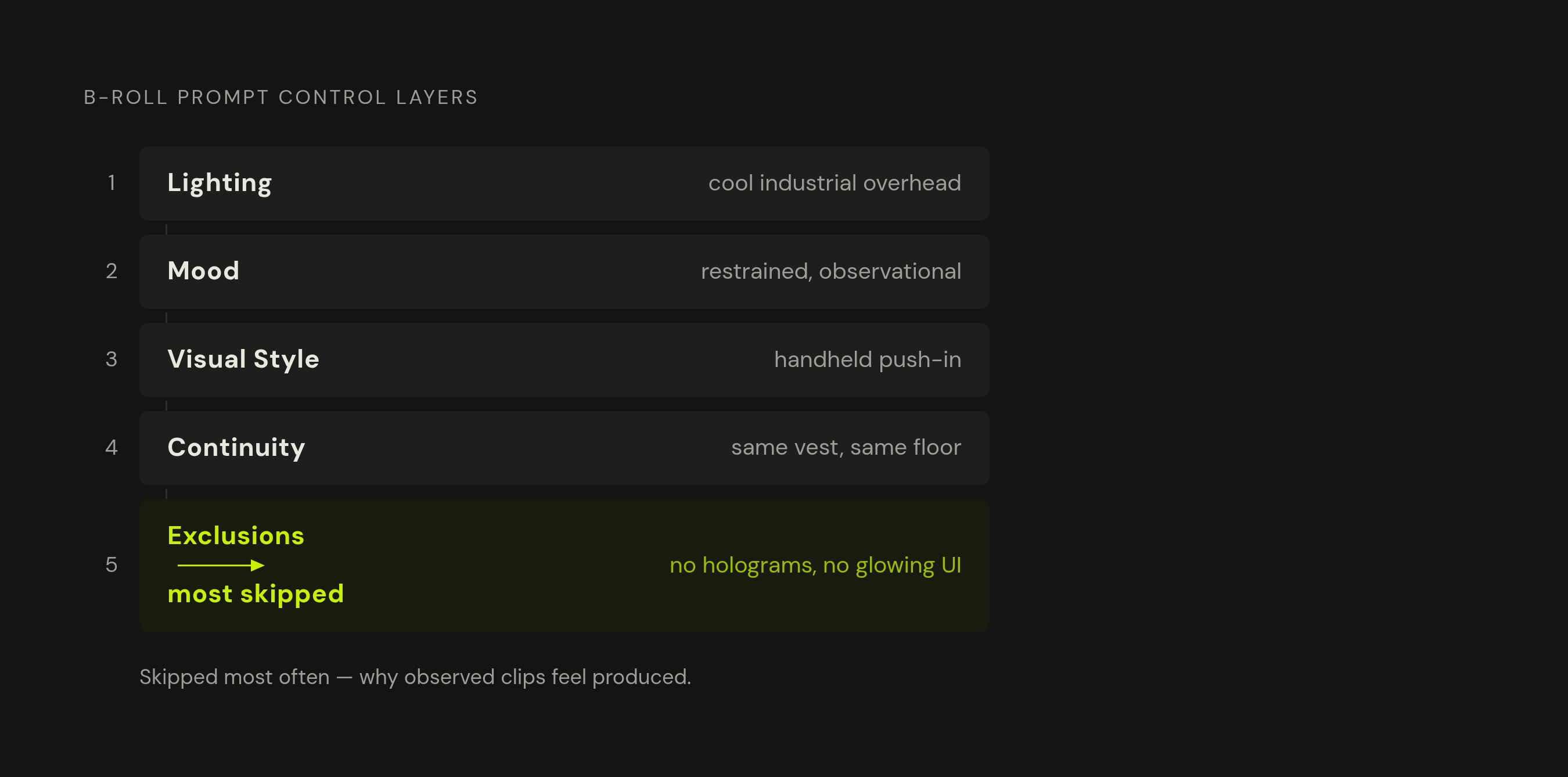
Reproducible documentary B-roll comes from treating a prompt as a specification, not a sentence. A single line describing a scene leaves too much to the model's defaults. Five separate control layers, each handling its own piece of information, is what keeps output consistent from clip to clip.
The first layer is lighting: time of day, direction, color temperature, contrast. "Natural industrial lighting, muted blue-gray palette" tells the model something specific and checkable. "Good lighting" tells it nothing.
The second layer is mood: the emotional register the clip needs to carry, stated outright so the model isn't left to guess. "Restrained" and "observational" point the model somewhere specific. If you leave mood unspecified, most models default toward something more dramatic than a documentary scene calls for.
The third layer is visual style, the documentary register itself: phrases like "realistic documentary footage," "handheld push-in," and "slow camera movement" name a category of footage for the model instead of relying on the subject matter to imply it.
The fourth layer is continuity: the anchors that have to stay the same across every clip in a sequence, same subject, same wardrobe, same location markers, so that five separate generations read as one continuous scene instead of five disconnected stock clips stitched together.
The fifth layer is exclusions: the specific things the model should leave out. "No holograms, no glowing interfaces, no readable logos" matters because, left to its own devices, a model will often drift toward cinematic spectacle, a glossy sci-fi sheen that reads as an ad. Of the five layers, exclusions get skipped most often, and skipping them is usually the reason a clip that should feel observed ends up feeling produced.
The warehouse supervisor prompt from the previous section carries all five layers at once: lighting ("natural industrial lighting, muted blue-gray palette"), mood ("restrained movement"), visual style ("realistic documentary footage"), continuity (the supervisor staying in the foreground while the robot moves behind her), and exclusions ("no holograms, no glowing interfaces, no readable logos"). Nothing in that prompt is left to inference.
Prompt complexity should also scale with how long the clip runs. A five-second clip can carry rich, multi-element detail without losing coherence. But an eight-to-ten-second clip works better if you build it around one primary action instead of several competing ones. Longer clips need a single clear narrative arc and a simple background, because extra detail causes a model to lose the thread over more frames.
How generation success rate shapes the workflow
Even a carefully engineered prompt won't give you a usable clip every time. A meaningful share of generations come back with some flaw, a morphing hand, a lighting mismatch, a background that drifts. That's a known property of the tools, and a documentary B-roll workflow has to budget for it the same way a film shoot budgets for extra takes.
In practice, that means generating in batches. A creator who generates a single take of each shot and moves on ends up with footage that doesn't match itself, lighting that shifts slightly between cuts, framing that drifts off the established visual language. Generating three to five variations of each clip and picking the strongest one keeps a sequence visually coherent.
Over time, documenting which prompt constructions reliably produce documentary-register footage, and which ones push the model toward spectacle instead, turns iteration into something faster. A creator who keeps notes on what works stops re-solving the same problem every time and starts pulling from a working set of proven phrasings.
Some shots are better routed around the model. Specific faces, branded environments, and complex multi-person scenes are where generation success rates drop the most. Supplementing those shots with practical footage or screen recordings keeps the documentary continuity intact without forcing a model to solve a problem it handles poorly.
Choosing the right model for each clip type in a documentary B-roll pipeline
No single model covers every kind of documentary B-roll well. Different clip types call for different strengths, and routing each shot to the model built for that job is as much a part of the discipline as the prompt layers themselves.
Veo 3.1, built by Google DeepMind, is the strongest option for consistent, brand-controlled scenes. It follows prompt structure closely, renders text reliably, holds color steady across clips, and outputs native 48kHz audio. That makes it the right tool for recurring location shots where continuity across a sequence matters more than anything else. Its weak point is motion: movement can read as slightly floaty next to the physics simulation other models offer.
Sora 2, from OpenAI, delivers the strongest physical-world simulation available, so you get the best high-impact hero shots from it. It also interprets prompts more tightly than Veo does, following complex instructions closely, which can introduce unpredictability that works against the steady, consistent register documentary B-roll needs across a sequence. That's the right choice for anchor moments, the handful of shots in a piece where visual impact matters more than tight, repeatable prompt adherence.
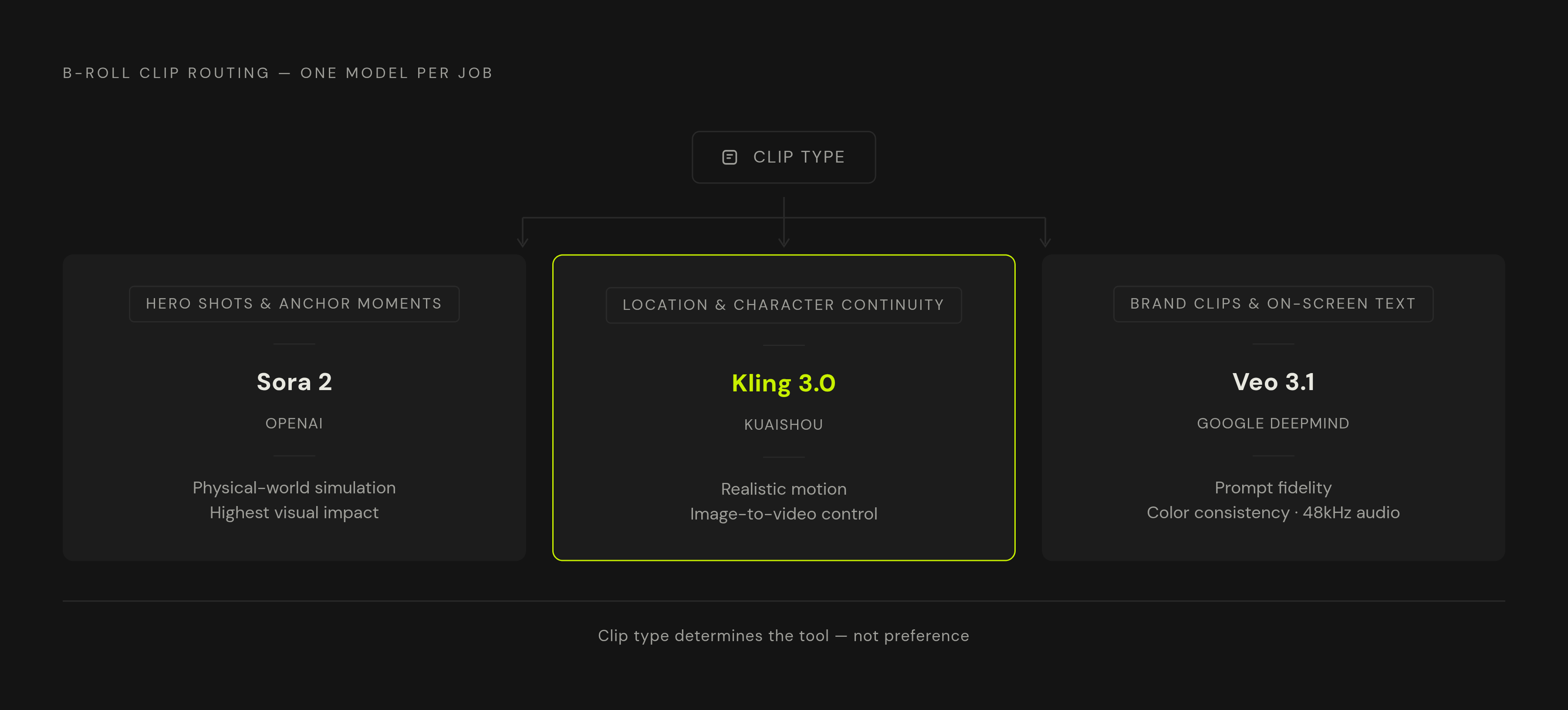
A practical routing logic follows from those two profiles. Hero shots and anchor moments go to Sora 2, where visual impact carries the clip. Location and character continuity shots go to Kling 3.0, which handles realistic motion and image-to-video control well. Brand-adjacent clips or any shot that needs legible on-screen text go to Veo 3.1, for its prompt fidelity and color consistency. A multi-model platform surfaces models like Veo and Kling through one interface, so you cut down the overhead of switching between separate tools mid-project, and that matters more as a pipeline scales across dozens of clips.
Adapting documentary B-roll pacing and shot rhythm to vertical short-form platforms
Documentary B-roll that's engineered correctly can still fail on a short-form platform because documentary filmmaking's native rhythm, slower cuts, longer holds, room to breathe, runs against how attention actually works in a vertical feed. Getting the clips right and getting the rhythm right are two separate jobs.
Each platform rewards a different cutting pattern. TikTok rewards fast snap cuts: a rhythm of three to five seconds per clip keeps the scroll-stopping energy the platform runs on, something documentary pacing alone won't sustain. Instagram Reels leans toward smoother transitions, swipes and polished cross-dissolves that fit the platform's more finished aesthetic without breaking the documentary tone of the footage itself. YouTube Shorts rewards something closer to editorial pacing: cross-dissolves and J-cuts carry more weight there than hard snap cuts do, which fits the slightly longer attention span the format allows compared to TikTok.
The vertical 9:16 frame itself changes what kind of shot even works. Wide establishing shots, a documentary staple in widescreen, lose most of their power once they're squeezed into a vertical frame. Close-ups, detail shots, and tight observational angles carry more visual weight in that format and should make up most of the B-roll selection for a documentary piece built for phones.
YouTube's 2026 disclosure rules for AI B-roll
YouTube's disclosure policy for AI-generated content, introduced in March 2024 and significantly updated in May 2026, is narrower and more specific than most creators assume. AI triggers the rule when it creates a believable false reality involving a real person, a real place, a real action, or a real event, not simply by touching a video somewhere in the pipeline.
That line matters directly for documentary B-roll. A generic warehouse supervisor in a generic warehouse, or a trail runner in a generic forest, doesn't require disclosure under the policy as written, as long as the footage isn't photorealistic enough to be mistaken for an actual recorded event. A clip that simulates a named public figure, a recognizable real location presented as factual footage, or a real news event does require disclosure, through the "altered or synthetic content" toggle in YouTube Studio.
Enforcement isn't manual anymore. Starting in May 2026, YouTube uses internal detection signals to flag videos with substantial photorealistic AI content, so if creators skip disclosure when it's required, the platform can apply the label automatically and override the creator's original choice not to flag it. In most cases, you can still contest or update an automatically applied label through the AI disclosure survey under Attributes in YouTube Studio.
A three-strike system governs inauthentic content and determines the financial stakes: a warning first, then a 90-day suspension, then permanent removal from the YouTube Partner Program. In January 2026, YouTube removed multiple major channels representing substantial combined annual revenue for mass-produced, inauthentic content that happened to be AI-generated, a sign that this enforcement is already running, not a policy sitting unused on paper.
For documentary-style B-roll creators, the practical boundary is straightforward. Illustrative AI footage depicting fictional or generic scenes and people stays outside the disclosure requirement. AI footage presented as real documentation of real people or real events is where the policy applies, and where the disclosure toggle needs to get used.