Sora vs Kling for Cinematic Short-Form Video
Kling dominates short-form video where Sora prioritized cinematic abstraction over production speed.
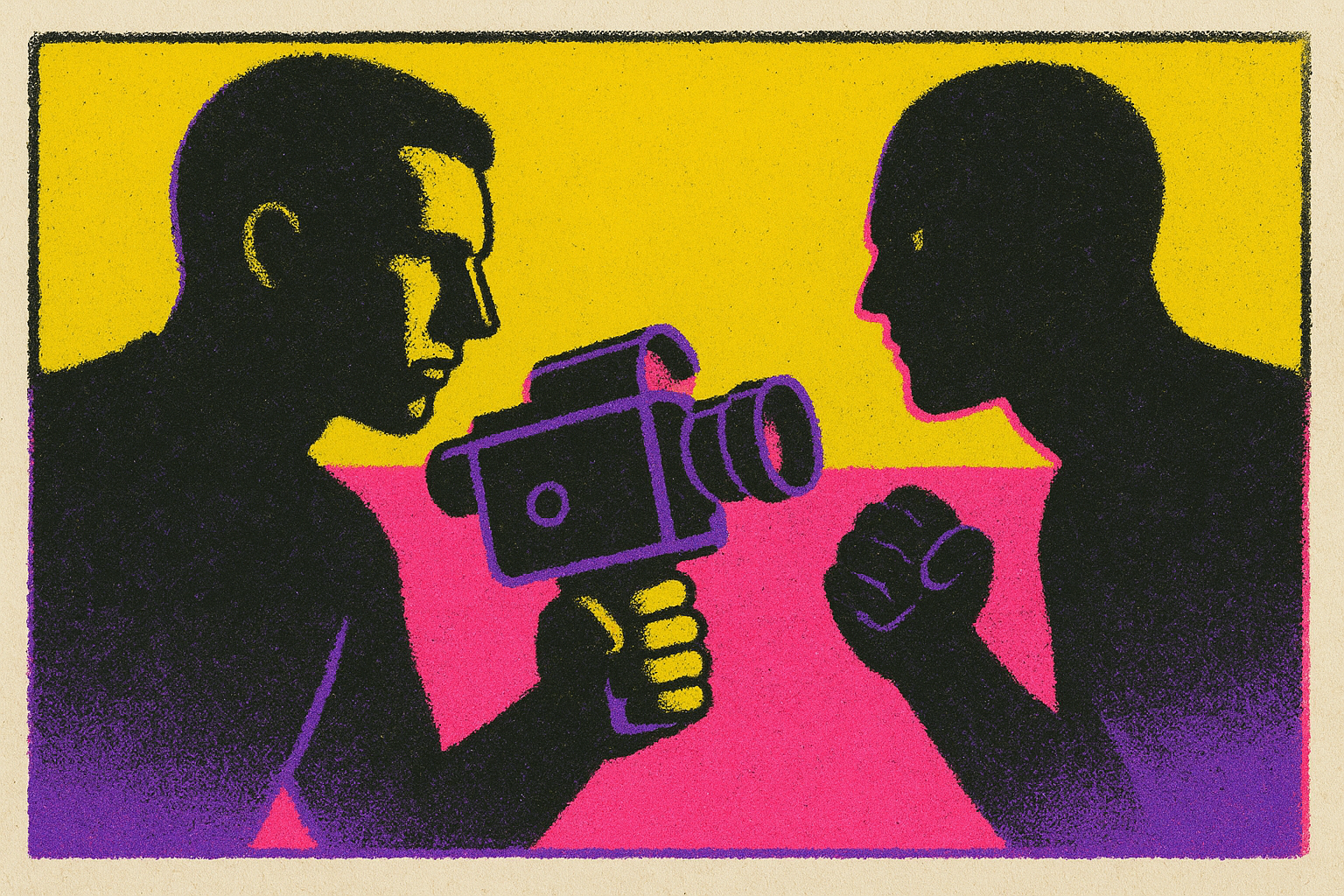
Sora is gone. OpenAI shut the consumer app down on April 26, 2026, and the API follows on September 24, 2026. Kling is now the default for creators who need cinematic short-form video, and that's not just a matter of timing. Sora and Kling were built to answer two different questions from day one, and the question that mattered for short-form survival was never the one Sora got good at answering.
Picking the wrong model here isn't a minor inconvenience. For teams shipping daily on TikTok or YouTube Shorts, it's the difference between a workflow that holds up and one that collapses the day a vendor changes course.
Sora 2 ran on a diffusion transformer with more than 3 billion parameters, trained on a proprietary set of over 10 million video clips. The key design choice: it treated video as 3D spacetime data, width by height by time, rather than a stack of 2D frames strung together. That changes how motion actually gets modeled, and it explains a lot about how Sora handled busy, complicated scenes.
Kling took the other route. Its architecture pairs a proprietary 3D Variational Autoencoder with a Diffusion Transformer, plus separate modules for 3D face and body reconstruction. Sora asked what a scene should feel like. Kling asked how a body, an object, a material actually moves. Those are different jobs, and they build different products.
The split isn't incidental, it's the whole story. Kling comes out of Kuaishou, a company that runs one of China's largest short-video platforms, so it shipped like an industrial tool built by people who already know what short-form content demands. Sora came out of a research lab chasing narrative coherence and abstract prompt interpretation first, with control and physical precision a distant second. Nearly every gap between the two models traces back to that split. Building for research-grade coherence is not the same job as building for a platform that needs billions of usable clips a day.
Where Sora's cinematic strengths actually lived
Hand Sora a vague, moody prompt, something like "melancholic atmosphere and cinematic lighting," and it delivered. Independent testing consistently found Sora outperforming Kling on abstract, atmosphere-driven prompts. That gap says everything about how Sora's training pushed it toward reading intent instead of following instructions literally.
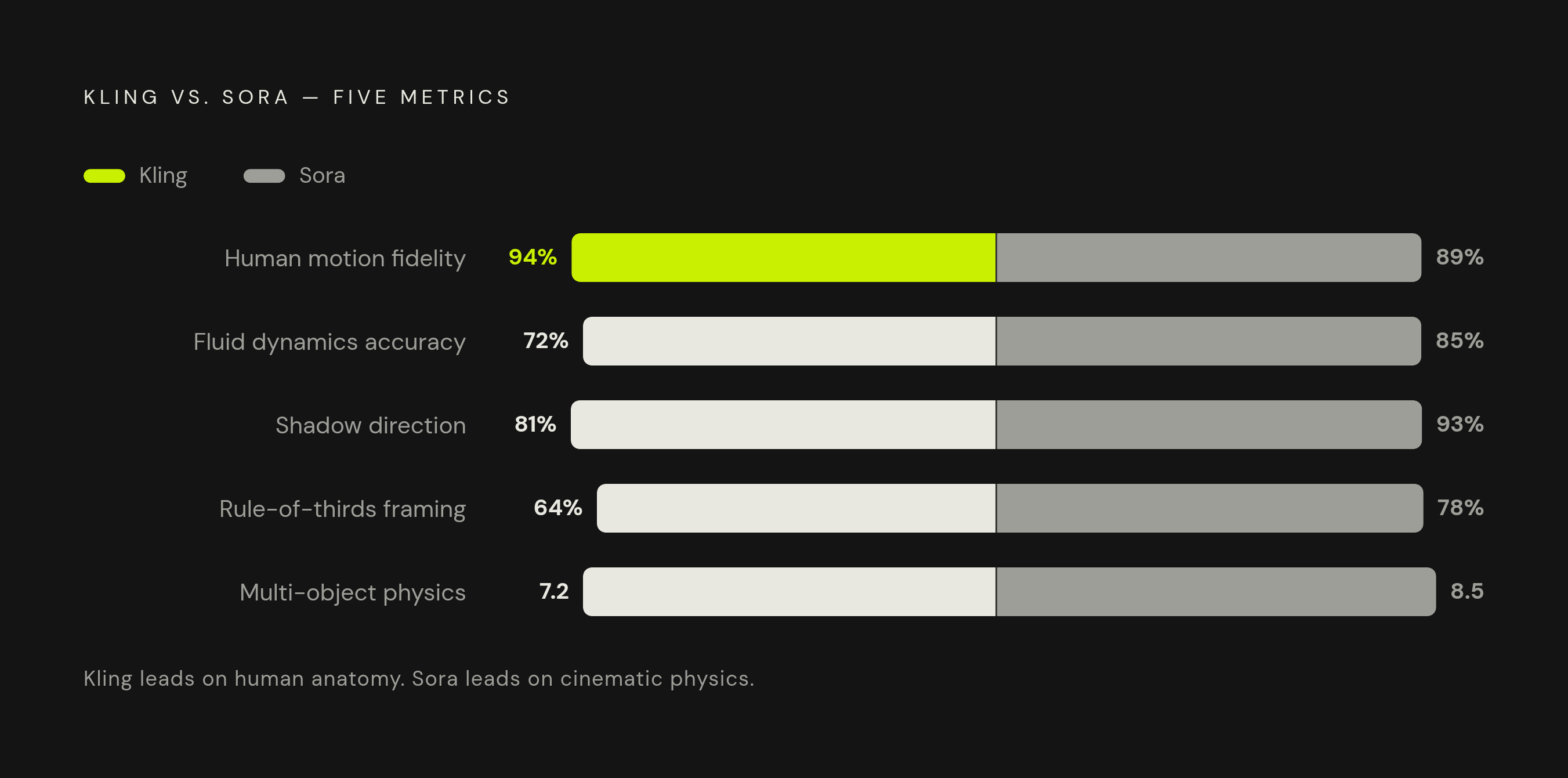
Sora also handled busy, multi-element scenes better. In multi-element compositional tests, Sora consistently placed and preserved distinct scene elements across generations. Framing followed the same pattern: 78% of Sora's frames matched professional rule-of-thirds composition, against 64% for Kling. Sora's shots often looked like choices a human cinematographer would make, not the safest average output a model could land on.
The physics numbers back this up. Sora scored 8.5 out of 10 on standardized multi-object physics prompts against Kling's 7.2. Fluid dynamics accuracy came in at 85% versus 72%, gravity simulation at 95% versus 88%. On a transparent glass table test checking spatial occlusion, Sora got it right 8 out of 10 times, while Kling showed depth ordering errors in 6 out of 10 attempts. Shadow direction was correct 93% of the time for Sora against 81% for Kling.
Sora also shipped something nothing else offered at launch: character cameos, letting a creator drop a specific person into a generated scene. Paired with clips running up to 25 seconds on the Pro tier, synced audio, and built-in dialogue, Sora came closer to a genuine short-film generator than anything else on the market. None of that was enough to keep it alive.
Why Sora's creative strengths didn't translate into a sustainable product
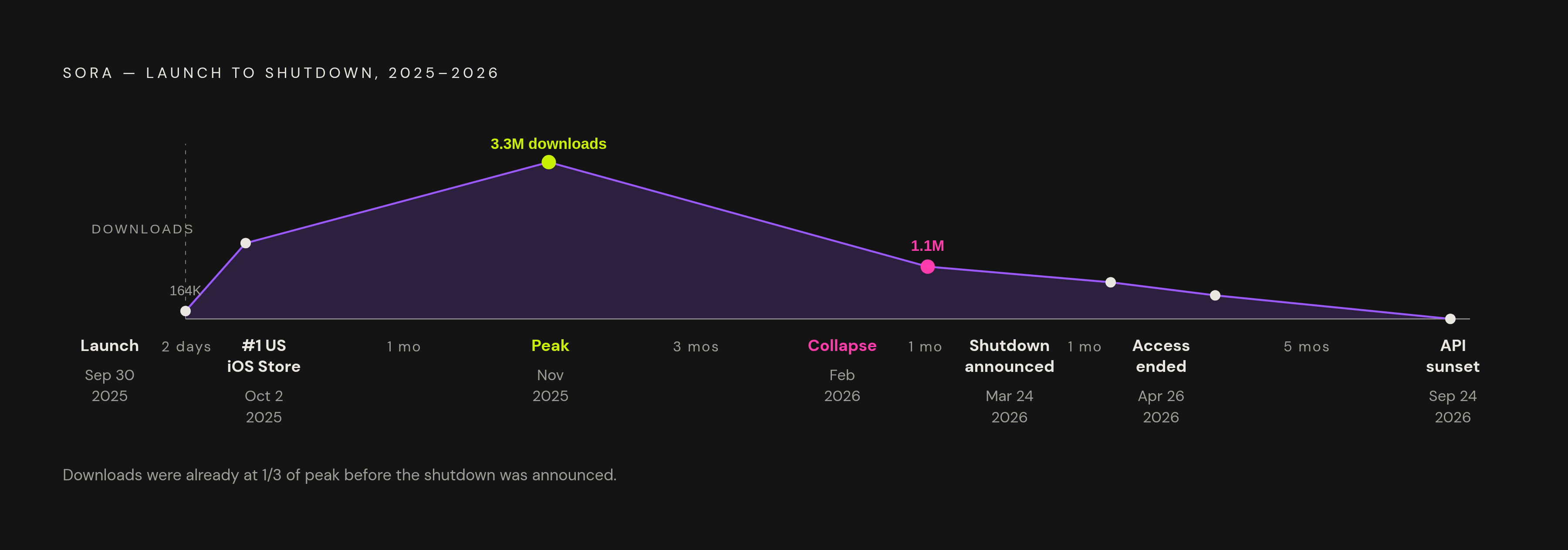
The app launched September 30, 2025, hit #1 on the US iOS App Store within 48 hours, and pulled in more than 164,000 downloads out the gate. Downloads peaked at 3.3 million in November 2025. By February 2026, that number had fallen to 1.1 million, and the collapse happened before OpenAI ever announced a shutdown. The product was already losing its audience on its own, well before any corporate decision forced the issue.
The economics never worked, and that's the part that deserves scrutiny. Running Sora cost roughly $1 million a day against total revenue of about $2.1 million. A planned $1 billion licensing deal with Disney, covering more than 200 characters, fell apart before it closed, and reports suggest Disney learned about the shutdown less than an hour before it went public. That's a reckless, disorderly wind-down. That's a company moving because it ran out of other options.
Generation latency was a constant complaint among professional creators. Clips took long enough to render that the basic loop of trying a shot, adjusting it, trying again, turned genuinely painful. Object permanence failures kept surfacing too, undermining confidence in production work even where the physics modeling elsewhere held up fine. A $200-a-month Pro plan, 10,000 credits a month is a hard sell when speed and consistency can't guarantee a usable clip inside a single session. Add copyright exposure, deepfake risk, and OpenAI's pre-IPO push toward profitability, and there was no version of the roadmap where these problems got fixed at the cost required.
The shutdown was announced March 24, 2026. Consumer access ended a month later, on April 26. The API follows September 24, 2026. Anyone still building on it needs content exported before that date, full stop.
What Kling 3.0 does differently, and why those choices fit short-form production
Kling 3.0 launched February 5, 2026, on a platform that had already grown from its June 2024 debut to 22 million users and 168 million generated clips. It hit an annualized revenue run rate of $240 million 19 months after launch. Set that next to Sora's six-month collapse and the two trajectories aren't in the same conversation.
The spec sheet explains the traction. Kling 3.0 generates at 4K resolution up to 60 frames per second, native clips run up to 10 seconds, with chained extensions available on paid plans. Human motion fidelity is 94% anatomical accuracy in joint position tracking against Sora's 89%, the motion capture training showing up directly in the output. Facial rendering follows the same trend: reviewers consistently rated Kling's subsurface scattering on skin (how light passes through and scatters under the surface) ahead of Sora's. For talking-head content and close-up lifestyle shots, a normal viewer notices that difference, not just a technician squinting at a monitor.
Kling's motion control tools are where its philosophy separates most clearly from Sora's. Rather than relying solely on text prompts, Kling gives creators direct, element-level control over movement. In practice, this produces tighter timing and directional accuracy than Sora's text-prompt-driven approach on equivalent motion tasks.
Kling also generates up to 6 connected scenes in a single pass, cutting out the manual stitching that made Sora's shorter clips hard to assemble into anything longer. Native audio-visual sync across 5 languages, lip-sync included, has been live since Kling 2.6 in December 2025. Aspect ratio support is designed for platform-native output rather than cropping down from one master output. For TikTok or Reels work, that's footage built for the platform versus footage squeezed into it after the fact.
Kling 3.0 Turbo, available through Leonardo.ai, renders up to 20 times faster than standard Kling 3.0 while holding onto visual quality, a direct answer to the latency complaints that dogged Sora. The pricing gap is stark too. Kling starts at $6.99 a month for 660 credits, with a free tier offering 66 credits daily at 1080p. Sora's Pro plan ran $200 a month. That's not just a pricing difference, it's two different markets.
The specific cinematic scenarios where each model's philosophy wins
Sora's territory, closed off now but still worth understanding, was abstract and mood-driven work: scenes that needed to feel authored, physics-heavy sequences with fluid dynamics or several interacting objects, anything chasing atmosphere over mechanics. Its 25-second native clip length allowed something close to a full narrative arc in a single generation, which suited story-driven ads or film-style shorts. That capability isn't available for new work anymore, but the design philosophy behind it still tells you what to look for in whatever eventually fills the gap.
Kling's territory is active, and it's growing. Human-forward content, talking heads, lifestyle footage, product demos involving hands and faces, is where its motion fidelity and facial rendering pay off directly. Its platform-oriented output makes it a natural fit for TikTok, Reels, and Shorts content built around people rather than landscapes or effects. Product and e-commerce video benefits from Motion Brush's precision on rotation shots and reveal sequences that would otherwise eat several tries before landing right. Multi-scene narratives are easier to build too, since multi-scene generation and chained extensions reduce the manual stitching required to build longer sequences.
Kling's spatial reasoning and abstract prompt handling still lag, and that gap doesn't fully close. It narrows with more literal, specific prompting, describing exactly what should happen instead of trusting the model to infer mood. Sora earned its edge there through training toward interpretation. Kling was never built for that, so the workaround means doing more of the interpreting yourself, in the prompt. Sora optimized for what a shot should mean. Kling optimizes for how a shot should move, and short-form social content rewards the second one, consistently. That's the whole reason this market shook out the way it did.
Where the AI video market stands now that Sora is gone
The leaderboard has shifted east. Artificial Analysis's Video Arena rankings from September 2026 put Kuaishou's Kling v3 at the top of the text-to-video-with-audio category with an Elo score of 1,934. Alibaba's Happy Horse 1.0 sits second at 1,816, and ByteDance's Seedance 2.0 Fast is third at 1,747. Chinese labs now hold the top of this market, and not by a small margin.
Two shifts define where things stand. Native synchronized audio, once a differentiator, is table stakes across every frontier model now. And the gap between prosumer and enterprise-tier output has narrowed enough that blind testers often can't tell the difference. Google's Veo 3 remains a strong enterprise pick for teams that need Google's infrastructure and stability behind the API. Veo 3.1 is still in Preview and doesn't carry that indemnification guarantee yet, so anyone assuming the newer version is automatically the safer bet should check that assumption before betting a production budget on it.
Seedance 2.0 and Happy Horse 1.0 rank well but aren't broadly available through stable public APIs, which makes them research-tier options rather than production choices for most teams right now.
The Sora shutdown leaves one lesson that applies no matter which model a team picks next: keep scripts, source footage, and edit decisions portable. Treat AI video as a layer inside the production process, not the foundation the whole workflow sits on. VideoGen's approach, routing work across Kling, Veo, Sora for legacy API access through September 24, Flux, and ElevenLabs through one interface, reflects that lesson directly. Access to whichever model fits a given shot, without betting the entire workflow on one provider staying in business.
How to choose between Kling and its alternatives for specific short-form formats today
For social-first content built around people, talking heads, Reels, TikTok, Shorts, Kling 3.0 is the default now. Not one option among several, the default. Native 9:16 generation, motion fidelity in the low-to-mid 90s on anatomical accuracy, lip-sync across 5 languages, and Turbo's speed advantage make it the practical pick for teams publishing on a schedule. The free tier, 66 credits daily at 1080p, is enough to test before committing to the $6.99 paid entry.
For cinema-grade texture and brand-safe enterprise work, Veo 3.1 is the real benchmark to weigh against Kling: stable API access, Google's infrastructure, strong lighting and material rendering.
For abstract or heavily compositional shots that need to feel authored rather than assembled, no single model closes the gap Sora left behind. Not yet, anyway. Structured, literal prompting narrows it inside Kling, and pairing different models for different shot types inside one project is the honest workaround here, not a permanent fix.
Teams working across multiple formats are usually better off routing each shot to whichever model handles it best, Kling for motion-heavy human content, Veo for texture and enterprise output, rather than standardizing on one tool for everything. VideoGen's multi-model access, spanning Kling, Veo, Sora until its September 24 API sunset, Flux, and ElevenLabs, lets a production team pull whichever model fits a shot without rebuilding a workflow every time a vendor changes course.
That's the real lesson the Sora shutdown exposes. Any single AI video model can get discontinued, repriced, or reworked without warning, and Sora proved it can happen in under a year from launch to sunset. The asset worth protecting is the production process itself, including the scripts, the source footage, and the edit decisions. Not a dependency on one company's model staying available.