Open-Source vs Proprietary AI Video Models for Solo Creators
Sora's shutdown proved that proprietary lock-in can crater your workflow overnight.
OpenAI deprecated Sora 2 on March 24, shutting down the web and app on April 26, with the API shutting down September 24. Anyone who had built a client pipeline around that single model spent the back half of the year scrambling for a replacement, and that scramble is the actual cost of picking a camp, open-source or proprietary, without weighing the trade-offs first. That single event is also the clearest sign that 2026 is the year this decision stopped being academic for solo creators. Open-source video models have moved from hobbyist experiments to tools people actually ship client work with, and the architecture behind that move is specific: diffusion transformers and Mixture-of-Experts designs have landed in open models, with Alibaba's Wan2.2-T2V-A14B as the first open-source video model built on MoE, closing a gap that used to make closed APIs the only serious choice.
Proprietary models didn't stand still while that happened. The leading ones now output 1080p or native 4K with lip-synced dialogue, and they keep a character's identity consistent across multiple shots, so the competition between camps tightened on both sides at once. Compare what making a 60-second branded video required in 2023, a script, a licensed stock clip, a voiceover session, an editing timeline, and about a week of nights, against 2026, where the hard part is no longer whether a shot can be produced at all but which model to produce it with. Picking the model has become the actual work.
The four trade-offs that determine which camp wins for a given creator
Four trade-offs decide which camp actually wins for a given solo creator, and none of them resolve the same way for everyone: cost structure, setup friction, output quality, and workflow flexibility. Cost structure covers more than the price on a pricing page. It includes hardware, time spent setting things up, and the maintenance that follows, and a proprietary sticker price hides cost in one direction while an open-source "free" license hides it in the other. If you compare signing up and generating a clip to installing Python, cloning model weights, and managing dependencies, that distance is big enough to decide the question on its own for a lot of creators. Output quality covers resolution, how real the motion looks, audio fidelity, and whether a character's face and body stay consistent from shot to shot, and the camp that wins varies by content type. Workflow flexibility is about fine-tuning on a creator's own footage, where that data lives, how often the model gets updated, and whether the whole thing can be folded into a pipeline that gets reused on the next job and the one after that.
What the Proprietary Models Offer a Solo Creator
The proprietary field in 2026 isn't one thing to choose or reject. Each leading model wins at a specific kind of content, and picking the wrong one for a job burns both money and the time spent re-rendering.
That makes Google Veo 3.1 the strongest pick for premium filmmaking and commercial advertising work, the kind of job where dialogue has to land in sync and hold up on a big screen. It runs on Lite, Fast, and Quality tiers, with AI Pro priced at $19.99 a month, Ultra at $249.99 a month, and API access starting at $0.03 per second. Every output carries mandatory SynthID watermarking, a real constraint for any creator who needs a clean deliverable to hand to a client.
Kling 3.0, from Kuaishou, offers a free tier alongside paid plans, with API pricing at $0.07 per second. Its generation speed makes it the strongest fit for human-centered scenes and short-form social content, because fast turnaround means you can test several prompt variations without long waits between each one. This model's vendor runs it out of its own servers abroad, so footage you send through it goes to that vendor's infrastructure, a detail that matters if you handle client footage or brand-sensitive material.
Seedance 2.0, from ByteDance, is the first model to do unified audio-video joint generation with phoneme-level lip-sync across eight or more languages, making it the strongest option for cinematic storytelling and dialogue-heavy scenes. It's also China-operated, so it carries the same data sovereignty consideration as Kling. In filmmaker testing it scores highest for cinematic quality, but it's harder to use than Kling or Veo.
Luma's Ray3, and its Ray3.14 update from January 26, 2026, is the first AI video model with native 16-bit HDR, and its Ray3 Modify feature lets a creator edit video-to-video on existing actor footage, starting at $7.99 a month. Its niche is HDR color pipelines and editing workflows where other models force a creator to start from a blank frame.
Sora 2's story in 2026 is the deprecation itself. OpenAI shut it down in stages, with the API closing September 24, 2026, and no new pipeline should be built on it now. Its exit reshuffled the competitive field and stands as the clearest example of what proprietary lock-in actually costs a solo creator who didn't plan around it, since any workflow built on Sora 2 now has to be rebuilt on another model entirely.
What the Open-Source Models Offer and What Running Them Requires
Open-source video models in 2026 are genuinely capable, but "free" describes the license, not the cost. Each model's output quality is tied to a hardware requirement, and you can't skip it.
Alibaba's Wan 2.7 comes in a smaller and larger text-to-video variant, plus image-to-video and video-editing variants, with 480p and 720p as its standard output. Wan 2.2 runs on high-end consumer hardware like an RTX 4090, it reads Chinese and English text cleanly, and it gives you real control over lighting style and composition. The larger variant needs a lot of VRAM to run well, and quality visibly drops once VRAM gets tight.
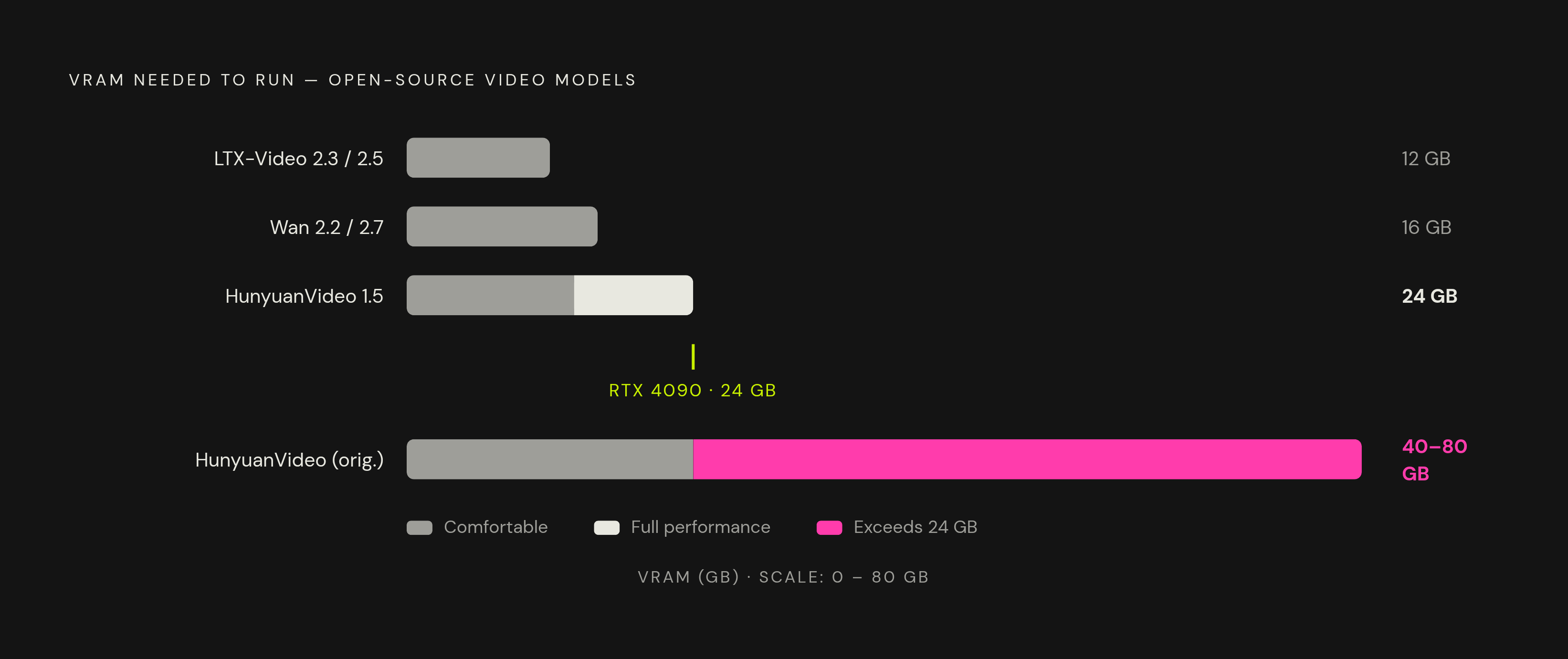
LTX-2.3 and LTX-2.5 models are free for academic use and for commercial use by companies below a defined ARR threshold, with tiered licensing above that threshold. Its training data is licensed from Getty Images and Shutterstock. Commercial output doesn't carry a copyright cloud, a real risk removed for any solo creator doing client work. It runs on a minimum of 8GB VRAM, with 12GB comfortable. The Pro and Fast variants of LTX-2.5 rank second and third in the Artificial Analysis without-audio open-weights category, behind MiniMax H3.
Tencent's HunyuanVideo 1.5 is built for realism and motion, the kind of model suited to corporate B-roll, scenario videos, and onboarding content. It needs at least 14GB of VRAM with offloading, and a consumer RTX 4090 at 24GB is the recommended setup for full performance. It runs comfortably at 24GB, but you'll see a visible quality cost at 16GB.
Skywork AI's SkyReels V1 is built on top of HunyuanVideo and fine-tuned on a large dataset of high-quality film and television clips, capable of rendering 33 distinct facial expressions and over 400 natural movement combinations for expressive storytelling. That makes it a strong fit if you need people-centered scenes and cinematic human portrayals where expression control carries the shot.
Alibaba's Wan2.2-T2V-A14B deserves its own mention as the industry's first open-source video generation model built on a Mixture-of-Experts architecture, producing 5-second clips at 480p and 720p while expanding the model's capacity while keeping inference costs nearly unchanged.
The hardware numbers across these models tell a consistent story. LTX Video needs 8GB of VRAM at minimum, with 12GB comfortable; Wan's larger variant is comfortable at 16GB; HunyuanVideo needs 24GB to run comfortably, and you'll see a visible quality drop at 16GB. A consumer RTX 4090 with 24GB handles Wan and LTX-2.3 without issue, and it's also what HunyuanVideo 1.5 needs for full quality. The original HunyuanVideo model needs 40 to 80GB of VRAM at full precision, but you can run it on a 24GB card through GGUF quantization, at a modest cost to quality.
Where the Cost Math Breaks
At low video volumes, a proprietary API costs less than self-hosting. At very high volumes, self-hosting wins out.
Kling's API runs $0.07 per second, and Veo 3.1's Fast and Full tiers charge more per second than that. If you post a 10-second clip every day, expect a real monthly bill even at the cheaper end of direct API pricing, and for a lot of solo creators that's still the cheapest path once you count the time spent setting up self-hosting.
Self-hosting looks free until the setup time gets priced in. Getting an open-source model running typically takes dozens of hours of developer time, and keeping it running costs another three to five hours a month in dependency updates and troubleshooting, hours that never appear in a headline about a "free model". GPU rental for A100-class hardware starts at competitive hourly rates, and a single generation takes two to five minutes, but at low volume that rental spend adds up faster than a flat subscription would.
The option most solo creators miss sits between these two paths: managed open-source APIs, which let a creator run an open-weight model like Wan or LTX without owning the GPU or doing the maintenance themselves. That shift has real consequences for how a solo creator builds a workflow in the first place, since the decision now is less about picking one platform forever and more about testing outputs across models as the field keeps moving. Multi-model platforms that bring together third-party AI models, open-source and proprietary alike, into one interface are built around that exact problem: they let a creator compare Wan, LTX, Veo, or Kling output on the same job without rebuilding a setup each time a better model is released. Setup friction carries real weight in this decision too: the distance between signing up and generating versus installing dependencies and managing GPU drivers determines which creators can actually run a repeatable production process at all. Platforms built to handle that infrastructure layer, the hardware management and model orchestration that self-hosting demands, reduce that friction to nearly nothing, which frees a creator to spend time on the creative decision, picking the right model for the shot, instead of on the technical scaffolding underneath it.