Persona and Likeness Rights in AI-Generated Video Advertising
Marketers must navigate a complex patchwork of state laws protecting voice and likeness rights.
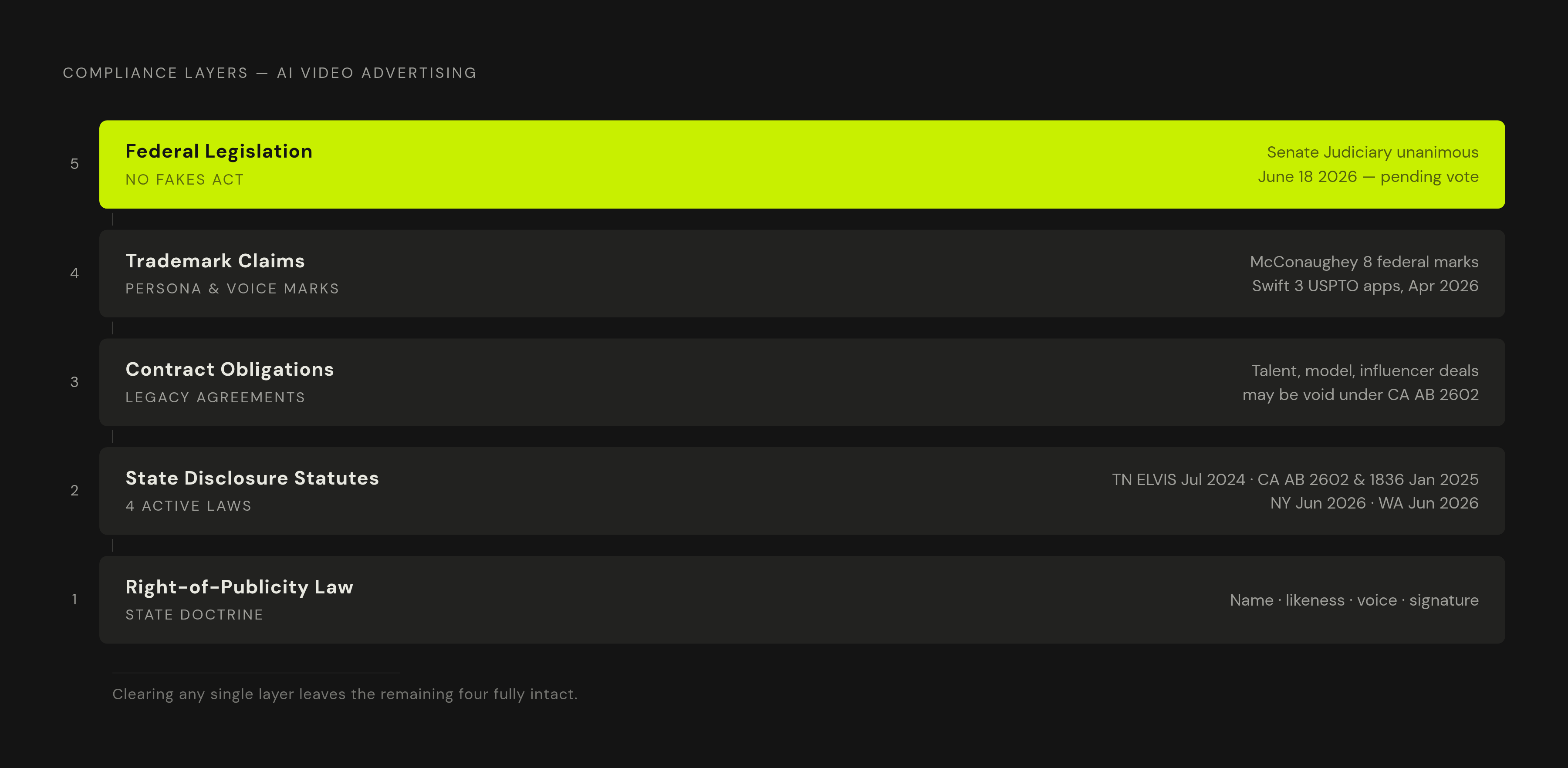
Using AI to generate video advertising that features human likenesses, real or synthetic, triggers a stack of legal obligations that most marketing teams have not mapped. The risk runs from right-of-publicity law through state disclosure statutes, contract gaps, and trademark claims, and now federal legislation is moving through the Senate. Each layer works on its own, so a campaign can clear one and still violate another.
Why AI video advertising creates a different legal problem
Traditional advertising needed a person to show up. A shoot required a contract, a recording session, a physical appearance, and each of those steps forced the advertiser to get consent before the identity could be used commercially. That production process built consent into the workflow by default. AI breaks that chain: a generated voice or face can enter a video ad without the person ever being contacted, recorded, or paid. The legal obligation to get permission did not go anywhere. Only the step that used to force compliance disappeared.
Copyright law does not close this gap. Copyright protects original works of authorship, and a person's voice or likeness on its own is not a copyrighted work. An AI-generated ad that imitates a singer's voice without copying any specific recording may leave the original performer with no copyright claim at all, even though the imitation is unmistakable.
The Supreme Court made this worse in a different direction. Its refusal to hear Thaler v. Perlmutter left standing lower-court rulings that purely AI-generated output carries no copyright protection. That puts an advertiser in an uncomfortable position: the video it just produced may not be ownable as intellectual property, yet the advertiser remains fully liable for any real person's identity embedded in that same video. A paid subscription to an AI video tool only governs the relationship between the advertiser and the tool. It says nothing about the person whose face got generated, the artist whose style shaped the output, or a trademark that wandered into frame.
Right-of-Publicity Law's Scope
Right of publicity fills the space copyright leaves open. The doctrine concerns a person's identity and the commercial value attached to that identity, not whether a specific work got copied. A generated image that duplicates no existing photograph can still create liability if it depicts a recognizable individual in a commercial setting.
What counts as protected varies by state, but the list typically includes name, photograph, likeness, voice, signature, and other recognizable characteristics. Voice needs its own attention, because a release that licenses someone's photograph may say nothing about synthetic voice generation. Those are separate grants, and courts treat them that way.
"Likeness" also reaches further than most advertisers assume. A digital replica can combine facial features, body shape, clothing, mannerisms, and gestures from a real person without naming that person once. A generated character who never gets identified by name but is recognizable to an audience can still generate a right-of-publicity claim. Advertisers who think about copyright first and publicity rights second tend to miss the claim that actually sticks. Courts have repeatedly declined to let ambiguous licensing language stretch to cover uses the agreement never contemplated, a pattern visible later in this piece through the Nicklaus case. The lesson holds here too: recognizability drives liability, not whether anything got technically copied.
The state-law patchwork advertisers must navigate today
If a national ad campaign targets one legal jurisdiction, it cannot ignore the rest. Once a video reaches a consumer in a given state, that state's law applies. The most restrictive law in the mix sets the real compliance floor for the entire campaign.
Tennessee moved first. Its ELVIS Act took effect in July 2024, and it became the first state law to address AI-generated voice replication directly within a right-of-publicity framework.
California followed with two statutes, both effective January 1, 2025. AB 2602, codified at Labor Code § 927, makes certain contract provisions unenforceable: if an agreement lets a digital replica substitute for a person's actual work, the contract must reasonably specify the intended use and the person must have been represented by counsel or a union. AB 1836 amended Civil Code § 3344.1 to require explicit estate consent before anyone can commercially use an AI-generated replica of a deceased personality, defined as someone whose name, voice, signature, photograph, or likeness had commercial value at the time of death. The practical result: generic consent boilerplate in a talent agreement is no longer a safe default for any campaign reaching California consumers where AI use is on the table.
New York built the most detailed framework. Its Synthetic Performer Disclosure Law and Posthumous Rights Amendment took effect on June 9, 2026. The disclosure law applies to anyone producing or creating advertising content that features a "synthetic performer," defined as a digitally created asset built with generative AI or algorithms designed to give the impression of a human performer who is not recognizable as any identifiable real person. Conspicuous disclosure is required once the advertiser has actual knowledge that a synthetic performer appears in the ad. The law reaches any ad that reaches a New York consumer, regardless of where the advertiser is headquartered. Exemptions cover expressive works, like movies, TV, and video games, where synthetic performer use fits the nature of the work, along with audio-only ads and AI used only for language translation. The posthumous-rights amendment protects deceased personalities domiciled in New York whose name, voice, signature, photograph, or likeness had commercial value at death or gained that value because of their death. Unauthorized use of their likeness triggers either a statutory damages floor or actual compensatory damages, whichever is greater, plus any profits attributable to the use and potential punitive damages on top.
New York is also where the contract problem is already playing out in court. The Nicklaus case confirmed that courts will not stretch ambiguous license language to cover uses the contract never clearly granted, a ruling with direct bearing on any brand that assumed its existing talent agreements already covered AI-generated versions of a person's likeness.
Washington state added its own layer: a law signed in March 2026 that took effect June 11, 2026. The law folds "forged digital likenesses" into the state's existing personality rights framework, extending established protections to cover AI-generated fakes without building an entirely separate statute.
The disclosure obligation that applies even when no real person appears
New York's synthetic-performer law creates an obligation that has nothing to do with consent. A fully invented AI character, one that resembles no actual person, still triggers mandatory disclosure if the advertiser knows a synthetic performer was used. Consent law asks whose identity got used. Disclosure law asks whether the audience knows they're watching something generated. Those are two separate questions, and treating them as one is a common and costly mistake.
Platform rules add another layer on top of the state statutes. YouTube, Meta, and TikTok all make creators flag realistic AI-generated or altered content. On YouTube, the upload-time checkbox for synthetic or altered media is a policy requirement on its own, and skipping it is a violation independent of whatever state law applies.
Labeling an ad as AI-generated does not resolve a right-of-publicity claim, a false endorsement claim, or a contract dispute if an unauthorized likeness appears in the footage. Disclosure and permission operate on separate tracks, and clearing one does nothing for the other.
The FTC's Endorsement Guides reinforce this from the consumer-protection side. They require clear and conspicuous disclosure of material connections, and those principles extend to AI-generated endorsements, virtual personas, and synthetic testimonial content. The agency also gives separate enforcement attention to AI-generated fake reviews and testimonials. Disclosure sets a floor for compliance. It does not provide a safe harbor against the claims covered in the sections above and below.
Where existing contracts fail when AI enters the production workflow
Most publicity releases, talent agreements, and influencer contracts were drafted before the current generation of AI tools existed, and they say little or nothing about what a company may do with a person's likeness once AI enters the production process. Broad legacy language granting rights to "edit," "reuse," or create "derivative works" was written with traditional post-production in mind. That language may not hold up when the edit in question is a synthetic recreation of the person.
AI replica rights ask for more than traditional licensing ever did. A digital replica can generate new performances, new dialogue, new facial expressions, and new endorsements the person never actually gave. A contract that permits a studio to use an actor's likeness to promote a film does not automatically permit the studio to generate an AI version of that actor for a separate ad campaign or social media push. California's AB 2602 makes a contract provision letting a digital replica substitute for a person's in-person work unenforceable unless the agreement clearly describes the intended use and the person had legal representation when they signed. Vague grants in that state are not simply risky; they are void.
The Nicklaus case backs this up from the courtroom side. Judges will not read ambiguous contract language as a transfer of rights the agreement does not clearly spell out. If a brand assumes a broad, perpetual license from years ago already covers today's AI uses, a court may see it differently.
Closing this gap means auditing the full contract stack, not just the obvious talent deals. That includes publicity and model releases, even the forms you use for employees, customers, and event attendees. It includes talent, spokesperson, celebrity, and brand ambassador agreements. It also includes influencer and content creator agreements that cover short-form video, affiliate marketing, and livestream arrangements. It includes vendor, agency, and production agreements that touch AI permissions, tool selection, platform labeling, approval chains, and disclosure responsibilities.
Updating those contracts means adding or sharpening a specific set of provisions:
- Precise definitions of "digital replica," "synthetic performer," and "AI use" that a business team can apply without calling a lawyer every time.
- Separate scope-of-consent clauses for AI editing of real content and for creating or using a digital replica, since these are distinct grants that should not share one vague sentence.
- Compensation for AI and digital-replica rights priced separately from standard appearance fees.
- Pre-publication approval rights for any AI-altered or AI-generated content that changes a person's appearance, voice, message, or context.
- Restrictions on feeding a person's likeness, voice, or biometric data into third-party AI systems without their separate sign-off.
Trademark law as a supplemental defense for public figures
Right of publicity is no longer the only tool public figures are reaching for. Some are registering federal trademarks on voice and persona elements, which opens a second enforcement path that an advertiser can trigger without ever touching a publicity-rights question. The perimeter around a person's identity is widening through private action as much as through new legislation.
Matthew McConaughey secured eight federal trademarks covering his voice and likeness, including his "alright, alright, alright" catchphrase. He framed the move around control, saying it ensures his voice or likeness gets used only when "it's because I approved and signed off on it." McConaughey also struck a licensed deal with ElevenLabs to allow authorized replication of his voice, which shows what a compliant AI replica arrangement looks like in practice: a specific, paid, consensual license, not a blanket assumption of rights. The two moves work together. The trademarks block unauthorized use, and the ElevenLabs deal shows the legitimate alternative.
Taylor Swift followed a similar path. In April 2026 she filed three trademark applications with the USPTO: two sound marks covering her voice, built around the phrases "Hey, it's Taylor Swift" and "Hey, it's Taylor," and a visual trademark tied to a distinctive stage image.
This strategy has a track record in court. In Waits v. Frito-Lay, Inc., Tom Waits successfully brought Lanham Act claims over an unauthorized imitation of his distinctive voice used in a Doritos commercial. Some legal scholars have raised doubts about how far trademark law can stretch to cover persona and voice claims generally. Even so, the practical signal for advertisers points the other way: clearing a right-of-publicity check and a contract review does not guarantee an advertiser is in the clear if the voice or persona in question has also been trademarked.
Federal legislation in motion and the NO FAKES Act's proposed changes
Federal law has stayed on the sidelines of this fight so far, leaving the entire burden on a patchwork of state statutes and private trademark filings. That may not last. On June 18, 2026, the U.S. Senate Committee on the Judiciary unanimously advanced S. 4591, the Nurture Originals, Foster Art, and Keep Entertainment Safe Act, known as the NO FAKES Act, by voice vote. The bipartisan bill now moves to the full Senate.
The NO FAKES Act would create a new federal intellectual property right giving every individual control over how their voice or visual likeness gets used in a digital replica. It would hold both individuals and companies liable for producing or distributing an unauthorized digital replica of a person's voice or likeness. If it passes, advertisers would get a single federal standard to clear, instead of fifty separate state regimes layered with private trademark claims. Until that happens, compliance runs through the state laws, the contract audits, and the disclosure rules already in effect today.
Sources
- Two Newly Enacted New York Laws Will Regulate Certain AI-Generated Images
- AI Is Rewriting the Rules on Likeness: Update Your Contracts Now - Lathrop GPM
- Can IP Law Protect Your Likeness and Persona from AI? - DR&A Law Firm
- Your Voice, Your Likeness, Your Rights: What Athletes and Entertainers Need to Know About AI and the Law
- Breaking Down the Intersection of Right-of-Publicity Law, AI - Blank Rome LLP
- New York Enacts Landmark AI & Right of Publicity Laws
- Senate Committee Advances Bill to Protect Name, Image, Likeness and Voice Against Unauthorized AI Use
- Digital Replicas, Synthetic Performers, and Advertising Law