ElevenLabs Voice Model Tiers for Video Voiceover
Choose the right ElevenLabs model to match your video's length and creative needs.

What each of the three current TTS models does, in plain terms
ElevenLabs runs three separate text-to-speech engines built for three separate jobs. Pick the wrong one for a video and money and render time both go down the drain. A 30-second ad and a 20-minute training module call for completely different tools, and that's the actual reason the tiered lineup exists, not some upsell scheme. This piece maps Eleven v3, Multilingual v2, and Flash v2.5 to the video formats each one actually handles well.
A lot of guides still floating around recommend Turbo v2.5. Skip that advice. ElevenLabs moved past that model in favor of Flash, so if a tutorial tells you to reach for Turbo, the rest of its advice is probably stale too.
Most people treat these three models like a quality ladder, with one sitting at the top. None of them is "better" than the others in any overall sense. Each wins on a different axis, and the axis that matters depends on what's actually getting made.
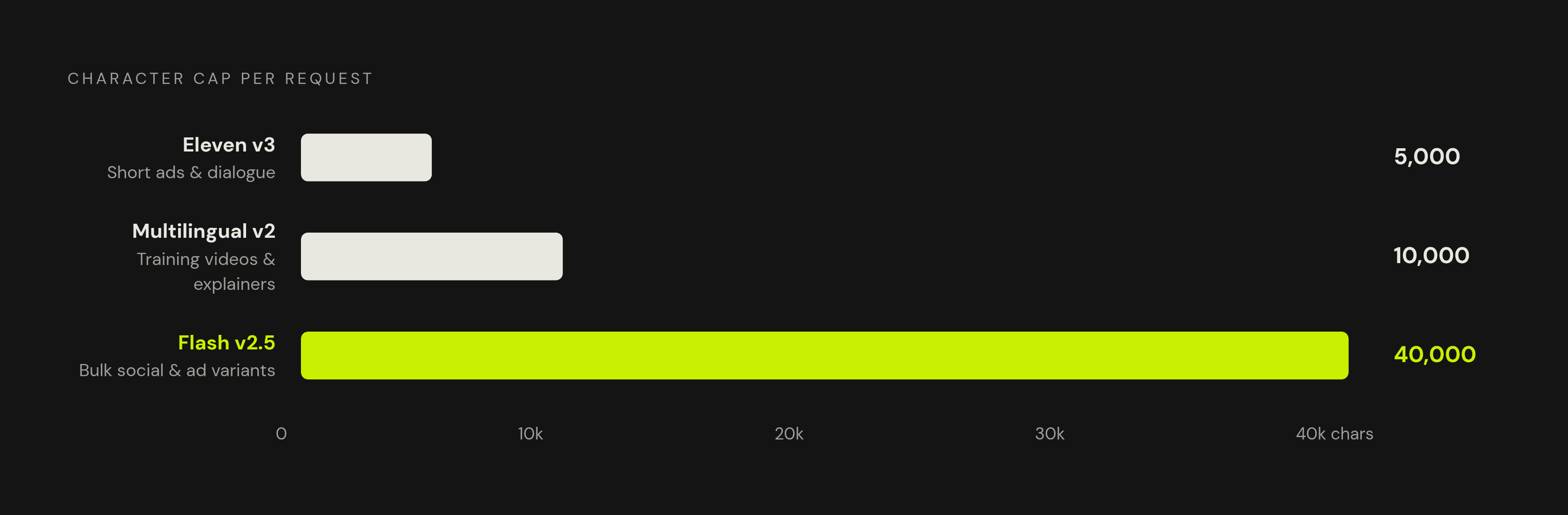
Eleven v3 is the expressive flagship. It covers over 70 languages, supports audio tags for controlling emotion and pacing, handles multi-speaker dialogue, and caps out at 5,000 characters per request. Latency runs at standard speed, not real-time.
Multilingual v2 is the long-form workhorse. It covers 29 languages, allows up to 10,000 characters per request, and holds up best across long generations without losing consistency. It sounds emotionally natural without needing tags to steer it.
Flash v2.5 is built for speed and volume. It covers 32 languages, runs at roughly 75 milliseconds of latency, allows up to 40,000 characters per request, and costs half as much per character through the API as the other two models.
Flash's character cap runs eight times larger than v3's, leaving the flagship model, the one tuned for the most expressive output, with the smallest limit of the three. That's not a bug. v3 optimizes for performance quality, Flash optimizes for throughput, and neither one is trying to do the other's job.
For scripts that run past a single request's character limit, ElevenLabs offers a stitching mechanism using previous_text and next_text parameters, which keeps pacing and tone consistent across chunks. That's the technical bridge that makes long-form narration workable at all, and it matters most for the Multilingual v2 jobs covered below.
Eleven v3 and the expressive voiceover jobs it was built for
v3's defining trait is directability. Instead of writing plain text and hoping for the best, creators drop bracketed audio tags right into the script, things like [shouts] or [excited], to control tone, pacing, and delivery. This replaces SSML markup entirely, and that swap is deliberate: tag-based direction produces output that sounds performed, where markup-based systems tend to produce something that sounds tagged.
On blinded listening panels, v3 scored a 4.6 MOS (mean opinion score) for voice naturalness in blinded tests. It's a first-party number, and no independent benchmark for v3 exists yet, so it should be taken with a grain of salt.
Where does v3 actually belong in a production pipeline? A few spots, and they share one trait: emotional delivery drives how convincing the output sounds, regardless of length.
- Short video ads and social spots where the emotional delivery has to land exactly right, not just sound competent
- Branded explainers where the voice needs a specific character, something performed rather than read off a page
- Multi-speaker dialogue scenes using Text to Dialogue, which only runs on v3 (the HTTP endpoint sometimes takes a few generation attempts to nail; a separate Realtime Text to Dialogue WebSocket handles live applications)
- Anything under roughly five minutes of audio per request
A few scripting habits matter here. Run stability around 0.5 to 0.65 for marketing content, since lower stability adds natural variation that keeps the read from sounding synthesized. Feed the model at least 250 characters of context, including emotional cues in the voice description, because v3 performs noticeably better with detail to work from. Results shift from take to take, and small tag tweaks can move the output meaningfully, so generating a few versions and picking the best one is standard practice.
Pronunciation runs through inline IPA notation inside forward slashes, which ElevenLabs documents at an 80 to 90% consistency rate. v3 doesn't support SSML break tags, so pacing control runs entirely through the tag system, no exceptions.
The 5,000-character cap is the whole reason v3 isn't the default answer for every job. That's a non-issue for a 30-second ad. It's a real constraint for a 15-minute training video, where the script has to get chunked and stitched, and that's exactly the kind of job v3 was never meant to carry.
Multilingual v2 and the long-form narration jobs it handles best
Multilingual v2's whole reason for existing is stability across long stretches. It holds a consistent voice character and emotional register through a full 10,000-character request, without losing consistency across long generations. That's double v3's character limit, which puts the practical ceiling at around 10 minutes of audio before stitching kicks in.
Where it fits, and this list runs almost entirely opposite to v3's:
- Training videos and e-learning modules, where the priority is consistent, authoritative narration over many minutes
- Corporate explainers, product walkthroughs, and presentation narration, formats that call for polish and neutrality over dramatic performance
- Gaming and animation voiceovers where some emotional range is needed but audio tags aren't
- Multilingual video localization, since the 29 supported languages hold consistent quality as the language switches
On the Creator plan, 100,000 characters a month works out to roughly five to seven twenty-minute training modules, or three to four ten-minute explainer videos. That's a production budget a team can actually plan a quarter around."
Pronunciation control here uses a different system from v3's inline IPA-slash syntax. Writers moving between the two models have to switch scripting habits accordingly, since the two systems don't share a vocabulary.
Multilingual v2 costs more per character and runs slower than Flash. For most async video production, that gap barely registers, since turnaround gets measured in minutes, not milliseconds, and latency was never the bottleneck for a training video.
Flash v2.5 and the bulk, scaled, and social content workflows it enables
Flash v2.5 combines roughly 75-millisecond latency, a 40,000-character cap, and pricing that runs 50% lower per character through the API than either v3 or Multilingual v2. It's the only model in the lineup built to handle real-time generation and bulk generation at the same time, and that dual role is what makes it the default for anything social.
It covers 32 languages: all of Multilingual v2's languages, plus Hungarian, Norwegian, and Vietnamese.
Best fits for Flash:
- Bulk social content, TikTok clips, Reels, YouTube Shorts, anywhere a team needs a high volume of short voiceovers turned around fast
- Ad creative testing, generating multiple voice variations of the same script to run A/B tests at scale
- Any workflow where cost-per-output matters more than expressive performance
- Multilingual social campaigns that need many language versions produced at once
On API overage, Flash runs $0.05 per 1,000 characters against $0.10 for v3 and Multilingual v2. That gap compounds fast once volume climbs into the millions of characters, and at that scale, the choice between Flash and the other two is a budget decision, not a style preference. Flash v2, the English-only predecessor, still sits in the model table and still works fine for English-only jobs, but Flash v2.5 matches its latency while supporting 32 languages against Flash v2's English-only coverage, so there's little reason left to reach for the older version.
Flash gives up some emotional range compared to v3, and no amount of clever prompting fully closes that gap. For social content where energy and a strong hook matter, the fix runs through tighter scripting and punchier sentence structure, not audio tags, since Flash doesn't lean on tags the way v3 does.
Paid plans also carry credit rollover, up to two months, capped at three times the monthly quota. Given how fast Flash burns through character allowances, that rollover becomes a real cushion for teams whose production volume swings month to month: a launch week followed by three quiet ones, say.
How pricing tiers align with each model's target workload
The real question at every tier is which model makes financial sense to run at that volume. Get that wrong, and a team ends up paying for capacity it never touches.
Free ($0/month): 10,000 characters, non-commercial use only, no voice cloning. Fine for testing v3's quality before committing to anything. Not viable for actual production, full stop.
Starter ($6/month): 30,000 characters, roughly 30 minutes of Multilingual v2 audio or 60 minutes of Flash, commercial license included, and this is where instant voice cloning unlocks. The real entry point for anyone making content that will actually get published.
Creator ($22/month): 100,000 characters, professional voice cloning for up to 30 voices, and generations extending to 20 minutes. This is the natural home for independent creators running either Multilingual v2 or v3 on a regular schedule.
Pro ($99/month): 500,000 characters and up to 60 minutes per generation. The best value tier for small businesses, since it covers high-frequency Flash production alongside occasional v3 work for hero content.
Scale ($299/month): a large monthly credit allotment, three seats. Fits teams pushing social content at real volume using Flash v2.5. ProVoice Clones at 44.1 kHz / 192 kbps require this tier or higher.
Business ($990/month): several times the credits of the Scale tier, ten seats. Built for high-volume production teams, with low-latency TTS priced down to $0.05 per 1,000 characters.
Enterprise (custom pricing): dedicated account management, custom voice model training, higher API rate limits, SSO/SAML support, and formal SLAs. Relevant mostly for regulated industries. SOC 2 Type 2, GDPR, and CPRA compliance are confirmed, with GovRAMP, FedRAMP, CJIS, and CMMC still in progress.
Costs shift meaningfully at high volume. At high monthly volumes, pricing becomes a real line item on a budget, and the biggest lever for controlling that line item is model choice: run Flash for the jobs where Multilingual v2 would be overkill, full stop. A simple rule of thumb: once overage spend hits roughly 30 to 50% of the next tier's flat price, upgrading beats paying per character.
Voice cloning options by plan tier
Two cloning tiers exist, and the quality gap between them is not subtle.
Instant Voice Cloning (IVC) unlocks at Starter ($6/month). It builds a usable voice from one to three minutes of clean audio. Fast, but it flattens some of the finer expressive detail in the source voice. That flattening matters for a lead narrator carrying a whole video, and matters much less for a background ad read nobody's parsing closely.
Professional Voice Cloning (PVC) unlocks at Creator ($22/month). It needs a minimum of 30 minutes of source recording, with more recording time improving results. Output at this level is described as nearly indistinguishable from the original speaker.
The top audio quality tier for PVC, 44.1 kHz / 192 kbps, requires Scale ($299/month) or higher. Recording for PVC works best in a quiet room, mic held at a consistent distance, recording at a natural speaking pace.
For video production, PVC paired with Multilingual v2 is the combination for creators who want one consistent branded voice across long-form content. IVC paired with Flash v2.5 covers bulk social content just fine, because that pairing prioritizes speed and cost over perfect voice fidelity, and for a 15-second TikTok ad, nobody's listening that closely anyway.
Consent isn't optional here, and this is the one place where cutting corners actually gets a team in legal trouble. Cloning someone's voice without their explicit written consent violates ElevenLabs' terms of service and runs afoul of right-of-publicity laws in most jurisdictions. ElevenLabs enforces this with detection models and account reviews, and most agencies in the influencer-marketing space say they'd reject a campaign outright if it used an AI voice clone without the original creator's documented consent.
A practical decision map: matching video type to model and plan
Start from the video type. That's the order production teams actually think in: figure out the format first, then work backward to the model and the plan that supports it.
Short video ads and social spots (15 to 60 seconds, high emotional stakes). Use Eleven v3, no substitute. The audio tags give tonal precision, the 4.6 MOS naturalness score backs up the delivery quality, and multi-speaker dialogue support covers scenes with more than one voice. Creator ($22/month) fits individual creators; Pro ($99/month) fits teams juggling multiple campaigns at once. Generate a few takes and pick the best one rather than accepting the first pass.
Training videos, e-learning, and corporate explainers (5 to 20 minutes, consistency over performance). Use Multilingual v2. It holds character and tone across long generations, and the polish it produces is what corporate and instructional content calls for, nothing flashier is needed. Creator ($22/month) covers most independent producers here, with Pro stepping in once monthly output climbs past a handful of modules.
Bulk social content and ad variant testing. Use Flash v2.5. The combination of low latency, the 40,000-character cap, and the 50% lower per-character API cost makes it the only sensible choice once volume, not performance nuance, drives the workflow. Scale ($299/month) fits teams running this kind of output regularly, with Business ($990/month) for agencies running it across multiple clients.
Match the model to what the job actually needs, not to whichever one sounds most advanced on paper. v3 for performance, Multilingual v2 for length and stability, Flash for scale. The video in front of you decides, not the spec sheet.