Multilingual AI Voiceover Production for Global Video Campaigns
Integrated pipelines reduce cost and error when translation, voice, and lip sync work as one.
Multilingual video localization used to mean running the same project over and over: a new cast, a new recording session, a new edit for every market a brand wanted to reach. The shift that changed this is that translation, voice synthesis, and lip synchronization, once three separate vendor relationships handled in sequence, now run as a connected pipeline. What used to happen one stage after another now happens close to simultaneously, with each stage feeding the next inside a single workflow.
That shift moved the bottleneck. The constraint now is understanding how the three pipeline stages interact and where they break down when handed off badly. A team that treats translation, voice, and lip sync as isolated tasks will still produce video, but slower and at a higher error rate, because errors from one stage pass silently into the next. Teams still running each market as its own production cycle are locked out of the speed and cost structure that pipeline-native teams operate at because they haven't restructured the work around the pipeline itself.
The rest of this piece works through that pipeline stage by stage: how translation is reviewed before it ever reaches a voice model, how voice synthesis and cloning differ in what they produce, why lip sync is the stage audiences actually judge, which models fit which production scenarios, and how to govern all of it at volume without losing brand consistency or legal footing.
The translation layer and the errors it introduces downstream
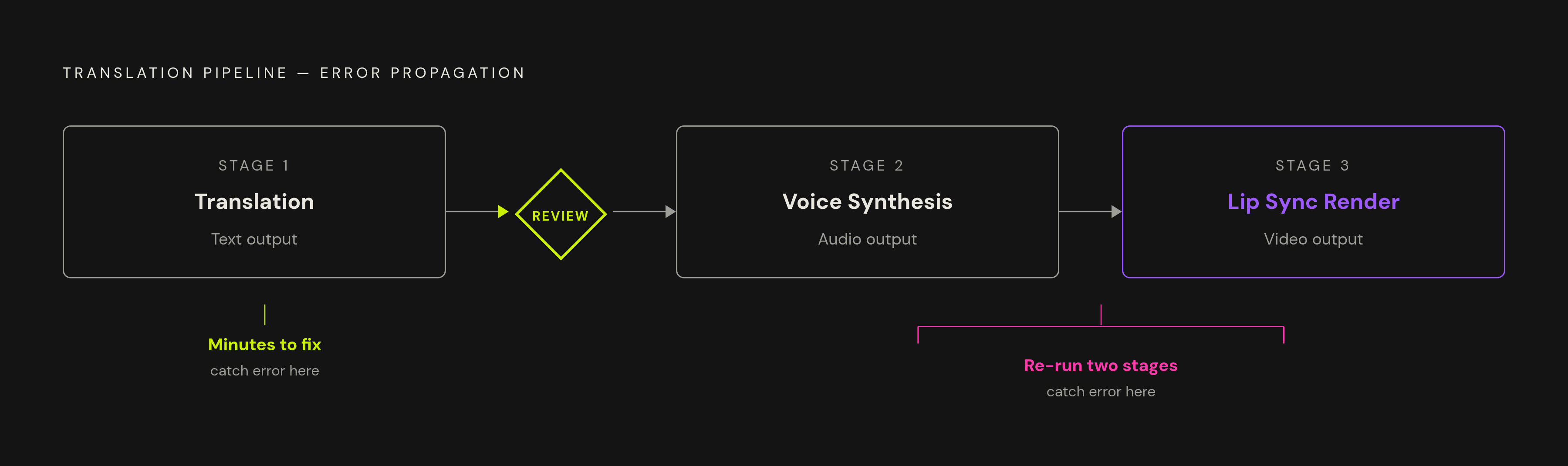
Neural machine translation now handles idiomatic phrasing and industry-specific terms without manual glossaries, because transformer architectures preserve contextual meaning across languages. Translated output also has to match the rhythm and duration of the source audio. Some languages run noticeably longer or shorter than English for the same sentence, and a script that reads correctly on the page can still break the pacing of everything generated after it.
This is where translation errors compound. If you catch a translation mistake early, it costs a few minutes to fix. Caught after full generation, it means re-running synthesis and lip sync for that clip in that language.
The structural fix is a review gate placed between translation and synthesis, not after. If you review translated scripts before they reach the voice model, you catch duration and idiomatic problems while they're still cheap to fix. For enterprise campaigns running many languages at once, building that review into the pipeline as a standing gate, rather than treating it as a separate vendor step, is what separates a repeatable process from one that needs per-language remediation after the fact.
Voice synthesis and voice cloning: what each approach produces
You get standard voice synthesis from libraries of voice personas, one built for each language. Voice cloning replicates a specific speaker's tone, pacing, and inflection from a short audio sample, then applies that same voice across every language version. The two approaches solve different problems, and picking the wrong one for a given campaign makes the brand sound inconsistent across markets.
Cloning exists for brand consistency. Resemble AI's Localize feature works this way: it preserves the original brand voice across language versions. A curated library voice, matched to regional accent and register, is faster to produce and more consistent in delivery than cloning a voice into a language it was never actually recorded in.
Several parameters need attention regardless of which approach is used. Accent calibration matters within a single language as much as across languages: Brazilian Portuguese is not European Portuguese, and Castilian Spanish is not Latin American Spanish, so a voice selected for one region will read as foreign in another even when the words are technically correct.
The legal boundary is straightforward to state and easy to miss in practice. Cloning anyone else's voice, including a public figure, triggers right-of-publicity exposure and, in several US states, voice-likeness statutes written specifically for this. Standard contracts signed before AI voice replication existed almost certainly don't cover it, so agreements need to spell out how, where, and for how long a cloned voice will be used instead of relying on old talent agreements to extend by default.
Lip sync and native-versus-dubbed perception
Audio-only voiceover laid over an original video creates a visible mismatch: the speaker's mouth moves to the original language while different words come out. Subtitles fix the audio mismatch, but your eyes leave the visual content to read them. Lip sync solves both problems by reshaping the speaker's visible mouth movements to match the translated audio, frame by frame, so the video looks like it was shot in the target language.
The mechanism behind this is phoneme-based mapping, which maps each language's phonemes to corresponding mouth shapes. If you train a lip sync model mainly on English, you get visibly wrong mouth movements in Mandarin or Arabic, because those languages' sounds don't map onto English mouth shapes.
Quality varies across this spectrum in ways that are easy to see once pointed out. When a close-up shows a speaker's face, you notice frame-level mismatch right away, even if you aren't looking for it, so talking-head and interview-format content exposes any failure here most acutely. That makes model selection far more consequential for interview and spokesperson formats than for footage where the speaker isn't dominant in frame.
AI video models for multilingual production scenarios
Choosing a model for a multilingual campaign isn't a single decision. It involves three separate questions: which model handles the generation format needed, whether that's a talking head or a cinematic scene, which model handles the range of languages the campaign requires, and which model delivers the lip sync precision that format demands.
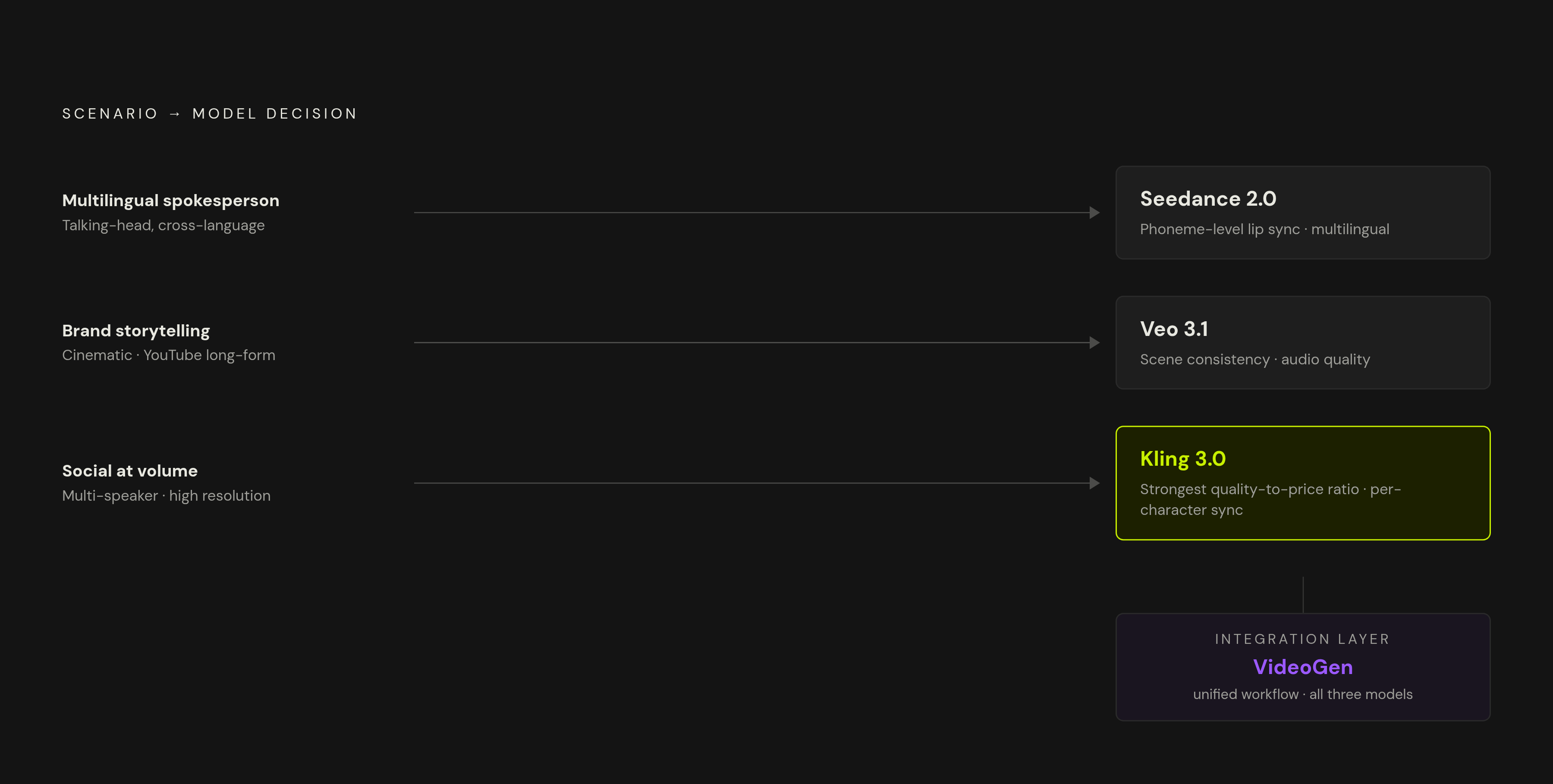
Kling 3.0 from Kuaishou produces high-resolution native output with synchronized audio built in as a standard feature, and it handles per-character lip sync, so it can render two speakers in a single conversation. At its API pricing, Kling 3.0 has the strongest quality-to-price ratio among the options here, so it's the best value choice for social content produced at volume.
Format and language needs point toward different models. If you need multilingual talking-head and spokesperson content, you can use Seedance 2.0, built for phoneme-level lip sync across distinct language families, the exact capability that interview-style close-ups demand. Brand storytelling, cinematic campaign work, and YouTube long-form content call for Veo 3.1, which holds scene consistency and audio quality across longer, more visually complex sequences. If you produce social content at volume, with high-resolution needs and multi-speaker scenes, you need Kling 3.0, for the value and native per-character sync described above.
If a campaign runs across formats and languages at the same time, you add real coordination overhead by managing these as three separate API relationships. Some platforms integrate Veo, Kling, and ElevenLabs, among other models, into a single interface, so teams don't have to manage separate API relationships or move assets between platforms as they move between pipeline stages. You can switch models inside one workflow, using a single login and export format.
Building a repeatable multilingual production workflow across a full campaign
A multilingual campaign follows a fixed production order no matter which models sit behind each stage: source video or script, translation with a review gate, voice synthesis or cloning, lip sync rendering, a quality check per language, and format adaptation per platform. Treating that order as fixed, rather than improvising it per project, is what makes the workflow repeatable.
Source preparation comes first. Time spent cleaning up the source pays off across every language version generated from it, letting you get it right once.
Translation with a review gate comes second. Catching a mistranslation at this stage prevents the kind of per-language remediation described earlier, where a single bad phrase forces a re-run of synthesis and lip sync after the fact.
Voice generation comes third. You set pacing and emotional register per language instead of copying them from the source parameters, because what sounds natural in English rarely sounds natural once it's ported unchanged into another language.
Lip sync rendering comes fourth. You match the model to the content format, talking head against scene-based footage, and you review output at the phoneme level specifically for languages far from the source language's phonetic family, where mismatch is most likely and most visible.
Platform format adaptation comes fifth. The same language version needs its aspect ratio and caption treatment adjusted per platform: 9:16 for TikTok and Reels, 16:9 for YouTube, burned-in captions for Reels, and caption timing adjusted for reading speed differences across languages, since a caption that reads comfortably in English can run too fast or too slow in another language at the same word count.
Two practices hold this together across a full campaign. On cost, the same staging principle that applies to single-language video at scale applies here: use faster or lower-cost model tiers for translation review, storyboarding, and internal approval passes, and reserve premium model generation for final output only.
Scaling multilingual production across teams and markets without losing brand or legal control
Once production volume grows, governance becomes the bottleneck, not generation capacity. You need to know whether every language version reflects approved brand voice, uses legally cleared assets, and meets each platform's requirements, without manual review on every single asset.
Brand governance at this scale rests on three pre-approved libraries: voice models, with documented consent records for any cloned voice; visual asset anchors, meaning brand-consistent images or footage used as generation inputs; and Master Prompt Templates built per content type and per platform. Without these in place ahead of time, every new market or team becomes a fresh negotiation over what's allowed, slowing everything down.
You need platform voice adaptation in this governance layer too, so it isn't left to individual creative judgment. If you define those variants in the template library ahead of time, rather than improvise them per asset, you keep every output consistent with brand standards without slowing down each piece of content.
Compliance works the same way. Some platforms support this governance layer directly, with pre-approved asset libraries, repeatable workflows, and team collaboration built into the same interface used for generation, so the controls that prevent brand drift and legal exposure live in the same place as the production work itself. Teams that skip this layer don't save time. They trade it for remediation work later, when an unapproved voice or an uncleared asset appears in a market after launch.
The authenticity problem: where fully automated multilingual pipelines can undermine the content they produce
As AI tools make polished, well-synchronized multilingual video easy to produce at volume, platforms fill with content that works technically but still fails to hold an audience. You decide whether to keep watching based on personality signals, so a pipeline optimized purely for accuracy and sync can strip those signals out even while it hits every technical benchmark.
This risk compounds specifically in multilingual work. A voice clone that preserves a speaker's tone faithfully in English can flatten regional emotional registers when applied to a language where prosody and expressiveness norms differ significantly from the source. Research on this backs up the concern directly: a 2025 study found that voice cloning systematically imposes a native English accent, collapsing variation in non-native English speech and erasing markers of cultural origin and individual distinctiveness. A separate study found that cloning can alter the accent-related speech patterns that contribute to how a speaker's identity is perceived. These are not edge cases. They show what the technology does by default when you apply it across languages it wasn't built around.
Designing human signal deliberately into the pipeline addresses this. Campaigns that perform best use AI to handle language volume while keeping the source performance, the original speaker's energy, pacing, and authenticity, as the foundation the pipeline builds from, instead of generating a fully synthetic performance from scratch in each language. When a campaign is linguistically accurate but culturally off in its imagery, reference points, or emotional register, it will underperform a less technically polished version that simply reads as native to its market. Human review of final per-market output belongs in the workflow as its own stage, not as an afterthought bolted onto the end of generation, because it's the stage that catches what no phoneme map or synthesis model is built to notice.
Putting the full pipeline into practice: what a production-ready multilingual campaign looks like end to end
A production-ready multilingual campaign runs the full sequence described above as one connected system, not as a set of disconnected vendor steps. Source material gets prepared clean. Translation has to pass through a review gate before it reaches a voice model. Voice generation applies cloning where you have a documented, consented brand voice, and library synthesis where you don't, with pacing and emotional register tuned per language. You match lip sync rendering to format, talking head against scene-based work, with phoneme-level review wherever the target language sits far from the source language's phonetic family. Platform adaptation handles aspect ratio and caption timing per destination. Governance libraries, covering voice models, visual anchors, and prompt templates, sit upstream of all of it, so brand and legal control don't depend on catching problems after they've already been generated.
What makes this a pipeline rather than a string of separate projects is that each stage is built to anticipate the one after it. Translation gets reviewed for duration because synthesis depends on it. Synthesis gets tuned per language because lip sync depends on it. Lip sync gets matched to format because the audience's perception of native versus dubbed depends on it. And human review sits at the cultural layer because no amount of technical accuracy upstream can substitute for it. A campaign built this way doesn't just move faster across markets. It holds together as the same brand, telling the same story, in every language it reaches.