Training Data Licensing Risks for Commercial AI Video Use
Training data risks now define what commercial teams can safely deploy.
A model, once trained on unlicensed material, cannot be untrained. That single fact is why training data, long treated as an engineering detail buried inside AI companies, now sits squarely on the desk of any marketing team, agency, or enterprise content group that uses AI video tools. Building a model means reproducing source material at scale, and that act raises copyright questions the moment training starts, not when a finished ad goes live. Training runs cost enormous sums and cannot be reversed once complete: deleting files after the fact does not undo what the model already learned, so any risk baked in at training time travels forward into every piece of output the model later produces. A brand that has already shipped ads, explainers, or product videos built on a platform later found to have trained on unlicensed content cannot pull the legal exposure back once the content is out in the world, even if it deletes the video itself. The question commercial teams now have to answer isn't whether the tool produces convincing footage. Output quality stopped being the debate a while ago. What the model was trained on and who owns that material doesn't have a settled answer yet.
The litigation surge that turned a theoretical risk into a documented one
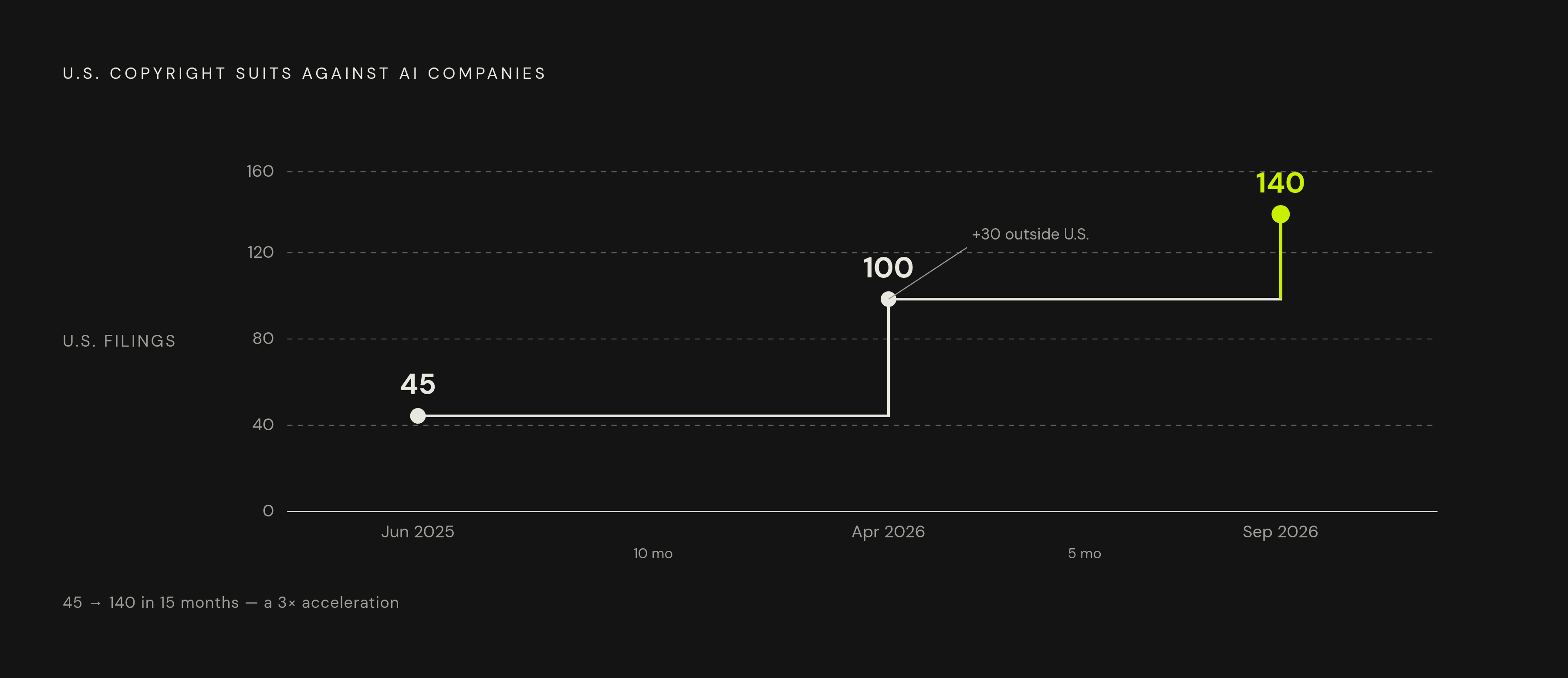
The scale of AI copyright litigation in 2026 makes clear this isn't a hypothetical risk anyone can afford to wave off. Law professor Edward Lee maintains a running case map, and it shows U.S. copyright lawsuits against AI companies hitting 140 by September 1, 2026, up from 45 at the end of June 2025, roughly a tripling in just over a year. By April 9, 2026, when the tracker passed 100 U.S. filings, at least 30 additional cases had been filed outside the United States, so the volume is a global pattern. peculiarity. It's a global pattern.
Video is squarely inside this wave. A video-generation model launched in February 2026, and it drew immediate cease-and-desist letters from several major studios and an industry trade association over unauthorized character and likeness generation. No lawsuit had been filed as of mid-2026, but the studios' response came fast and came from nearly every major player in the industry. Midjourney faced a more advanced version of the same fight: Disney, NBCUniversal, and DreamWorks sued the company in June 2025 over training on copyrighted works, including depictions of their characters.
Text-based cases are producing sharper legal theories that will likely shape video litigation next. A July 10, 2026 class action brought by Hachette, Cengage, Elsevier, and novelist Scott Turow against Google alleges that Google intentionally removed or altered copyright management information, the metadata identifying who owns a work and under what license, to obscure where its training data came from. That claim alleges active concealment rather than just unauthorized use, making it a more serious legal claim than standard infringement.
None of this should read as settled law in either direction. The 2025 Bartz settlement, often cited as a landmark, binds only the parties involved and sets no precedent that other courts must follow. The fair-use question it appeared to resolve remains open for every platform that comes after it. And the appellate case most likely to set real precedent is Thomson Reuters v. Ross, was argued at the Third Circuit on June 11, 2026, with no decision yet. Until that ruling lands, the central legal question behind all of this stays unanswered.
What Courts Have and Haven't Decided
No U.S. court decision as of September 2026 has settled whether generative AI training is lawful or unlawful as a general matter. Courts keep applying the same four-factor fair use test, the one that weighs the purpose of the use, the nature of the copyrighted work, how much of it was used, and the effect on the market for the original, and keep reaching different outcomes depending on the specific facts of each case. That inconsistency is the whole problem for anyone trying to plan around it.
One finding stands out for video specifically. The U.S. Copyright Office concluded in May 2025 that AI developers who train models to generate expressive content that competes with the original works used in training go beyond what fair use protects. AI video tools generate ads, explainers, and marketing content, and they compete directly with human-made creative work in the same markets, so this exact category of use sits closer to the line the Copyright Office drew.
The CMI removal claim against Google adds a second, separate layer of exposure. CMI, copyright management information, is the metadata that identifies who owns a work and what license governs its use. A claim that a platform stripped that metadata to hide where its training data came from is a distinct statutory violation, separate from copyright infringement, and it signals that courts and plaintiffs are developing legal theories that go beyond the traditional fair-use fight.
Some will argue this all gets resolved in AI companies' favor eventually, and that may well happen. But a team running paid ad campaigns or shipping client deliverables today can't build a release schedule around a future appellate ruling. Because training risk can't be undone once a model exists, the exposure a platform carries today doesn't wait for the Third Circuit's calendar to clear.
How Regulatory Pressure Is Forcing Training Data Into the Open
While courts work through fair use case by case, regulators have started requiring disclosure regardless of how those cases turn out, and that is changing what commercial teams can demand from a vendor before signing a contract. The EU AI Act is the clearest example. Its Article 53 transparency requirements for general-purpose AI models took full effect on August 2, 2025, and starting August 2, 2026, the European Commission can enforce them, including fines of up to 3% of a company's global annual turnover. Providers must publish a detailed summary of their training content using a binding template from the EU AI Office, listing data sources (the dominant domain names behind web-scraped content) and describing how they handle things like opt-out requests. A separate copyright policy is also required under Article 53(1)(c), though it isn't part of the mandatory template itself.
This applies well beyond companies headquartered in any single region. The AI Office can send information requests to any provider offering a general-purpose model inside the EU, regardless of where the company is based.
What's already visible from early compliance is a gap between what companies publish and what the rules ask for. OpenAI's published compliance narrative addressed two of the three chapters required under the EU's Code of Practice in real detail, but left the Copyright chapter, which requires a documented compliance policy, an opt-out mechanism, and a process for rightsholders to file complaints, largely unaddressed. That's separate from the public training data summary required under the Transparency chapter, and its absence is a meaningful gap on its own.
Microsoft's MAI-Thinking-1 model shows how wide the gap between a company's public claim and its technical documentation can run. At Build 2026, Microsoft's AI chief described the model as trained on "clean, commercially licensed data without distillation." The technical paper published alongside it tells a different story: a pipeline built mainly on a proprietary web crawl covering billions of pages, with Common Crawl also folded in as a component. Calling training data "clean" or "licensed" is a claim a company makes in a keynote, not a verification anyone outside the company has performed, and the published paper shows why that distinction matters.
U.S. legislation is still catching up, but it's already shaping behavior. The TRAIN Act, introduced January 22, 2026 by Representatives Madeleine Dean and Nathaniel Moran, would add a new Section 514 to the Copyright Act, letting rights holders obtain a federal court subpoena, without prior judicial review, to compel disclosure of training data if they have a good-faith belief their work was used. The bill is early in the legislative process, but AI companies are already adjusting how they document their data pipelines in anticipation of exactly this kind of mandatory disclosure. The pattern isn't limited to the U.S. and EU either: the UK, Canada, Japan, and several U.S. states have introduced bills following the EU's disclosure template, making provenance reporting the global default.
For commercial teams, the practical upshot is that these documents now exist and can be checked against what a vendor says in a sales call. Around 24 GPAI providers have signed the EU's Code of Practice, including Anthropic, Google, Microsoft, Mistral, and OpenAI. Meta has not signed. The summaries these companies file are verifiable documents, not marketing copy; a commercial team can request one and compare it directly against whatever claim a vendor made in a pitch deck.
Where the Exposure Is Sharpest
Training data risk doesn't spread evenly across every way a company might use AI video. It concentrates hardest in the exact workflows marketing teams, agencies, and enterprise content groups run most often.
Paid advertising and client deliverables sit at the top of the list. Many large enterprises now require that any AI tool used for this kind of work come with licensed training data and indemnification built into the contract before they'll approve it. Indemnification means the vendor commits, contractually, to cover certain legal costs if a third party brings a claim. Without it, the company that published the ad, not the platform that generated it, is the one left holding the risk if a rightsholder comes forward.
Voice and avatar workflows carry their own distinct exposure. In 2026, professional voice actors filed coordinated class actions alleging that their voiceprints were pulled from public recordings and used to train voice models without consent. A related class, certified in 2025, covers roughly 1.2 million Illinois residents whose voiceprints were created without authorization. Corporate training videos, product explainers, and localized ecommerce content built using AI voice and avatar tools all sit inside this same exposure, because the underlying voice models were trained the same way.
Likeness generation carries a similar warning. The Seedance 2.0 cease-and-desist letters show that even a platform offering commercial licenses on its paid tiers can still carry IP risk too high for professional use, if the model's training data is itself contested by rightsholders. A commercial license from the platform doesn't settle the underlying question of whether the training data was lawfully obtained in the first place.
Building a production pipeline around a single vendor's API adds a different kind of risk, and that risk compounds the others. OpenAI discontinued the Sora web and app experiences on April 26, 2026, and the Sora API itself is scheduled for discontinuation on September 24, 2026. Teams that built workflows entirely around that one API absorbed both the IP exposure tied to that model and the operational disruption of losing access to it with a hard deadline. Depending on a single vendor doesn't just concentrate legal risk. It concentrates operational risk at the same time, and a platform's business decision to shut down a product can hit a production pipeline just as hard as a legal claim can.
Free-tier usage deserves its own warning, separate from the paid-tier risks above. Many platforms' free tiers require users to grant the provider a broad, often irrevocable license to display, reproduce, and reuse generated content, including for further training. That structure doesn't mix well with corporate confidentiality. A marketing team that uses a free tier to generate a preview video featuring an unreleased product design may have unknowingly given the platform the right to surface that footage publicly, simply by agreeing to the terms of service.
Evaluating a Platform's Training Data Posture
Checking a platform's actual training data posture starts with finding its EU AI Act Article 53 summary, since any general-purpose AI model now has one on public record, and reading it specifically for whether the Copyright chapter is addressed rather than skipped, the way OpenAI's narrative left that section thin. A missing chapter is a signal about what the company is and isn't willing to put in writing.
From there, the summary needs to be read carefully enough to tell licensed data apart from scraped data, because the two terms get used almost interchangeably in sales conversations despite meaning very different things. Common Crawl, the most widely used web-scraping source in the industry, makes no licensing claims at all and pays no rightsholders for the content it collects. Asking a vendor directly which sources are licensed, from which rightsholders, and whether the platform respected opt-out signals like robots.txt or copyright metadata gets past the vague language and down to a specific answer.
Indemnification is the next thing to pin down, and it has to be checked as a contract term rather than taken as a sales promise. The questions that matter are concrete: what dollar amount the indemnification is capped at, whether it covers video and voice output or only images, and what kind of user behavior, such as adding unlicensed footage or using a beta feature, voids the protection.
Finally, whether any of these protections apply depends on the tier a team is actually paying for. Indemnification and training-data commitments are frequently written into enterprise or business contracts only. A team running campaigns on a consumer-tier plan may have no contractual protection, even if the vendor's enterprise product down the hall is built the right way.
Sources
- The “TRAIN Act”: Forcing Transparency in AI Training Data - Berkeley Technology Law Journal
- The Data Provenance Initiative: A Large Scale Audit of Dataset Licensing & Attribution in AI
- Challenges of data licensing in the U.S.: What is ‘fair use’?
- AI Training Data Lawsuits 2026: What the Google and Anthropic Cases Mean for Your Company