Copyright Status of AI-Generated Video Under US Law
US law denies copyright protection to AI video without meaningful human creative control.
A creator downloads a video clip generated entirely by an AI model and wants to know who owns it. Under current US law, the answer is nobody. Copyright attaches only to works of human authorship, and a video produced by a model responding to a prompt, with no meaningful human control over how the shot looks, moves, or cuts, does not qualify for protection. This isn't a gray area or an open question waiting on a future ruling. It traces back to a case brought by Stephen Thaler, who tried to register a work generated by a system he called the Creativity Machine, listing the machine itself as author. The courts said no at every stage, and the DC Circuit issued a unanimous opinion in March 2025 holding that the Copyright Act requires all eligible work to be authored in the first instance by a human being. In March 2026, the Supreme Court denied Thaler's petition for review, so that DC Circuit ruling now stands as the law. Because every challenge to a Copyright Office registration decision gets heard in the DC Circuit and nowhere else, that single appellate court is the only one positioned to rule on this question, which makes its human authorship requirement about as settled as a statutory interpretation gets without a Supreme Court decision on the merits. The Copyright Office backs this up from its own side of the desk: its Part 2 report on AI states that outputs of generative AI can be protected only where a human author has determined sufficient expressive elements, and simply typing a prompt does not clear that bar.
What "human authorship" actually requires, and why a detailed prompt does not satisfy it
If prompting isn't enough, the next question is what counts instead. The Copyright Office looks at who controls the expressive choices in a piece of work, and draws its line there. If the AI model is the one deciding how a scene is framed, lit, paced, or composed in response to a prompt, the human typing that prompt hasn't exercised the kind of creative control copyright protects, no matter how long or detailed or carefully iterated that prompt was. The report says this outright: prompts alone don't give a user enough control over the output to make them its author. If the wording has enough human expression, you might earn copyright on a detailed, original prompt as a piece of writing, but that protection covers only the prompt. It does not extend to the video the model generates in response to it. The Office's own comparison is useful here: using AI as a tool doesn't disqualify a work from protection, any more than using a camera, Photoshop, or a word processor does. That comparison goes back to 1884, when the Supreme Court decided Burrow-Giles Lithographic Co. v. Sarony, which extended copyright to photography because the photographer made real creative choices about pose, lighting, costume, and props. The same question applies to AI video: did a human make those choices, or did the model? And effort alone won't settle it. You can spend hours refining a prompt, but copyright has never paid out for labor alone. The Supreme Court rejected that idea in Feist Publications v., and it's known as the sweat-of-the-brow doctrine. Rural Telephone Service, and the same logic applies here: time spent is not the same as creative control exercised.
The three kinds of human contribution that can make AI-assisted video copyrightable
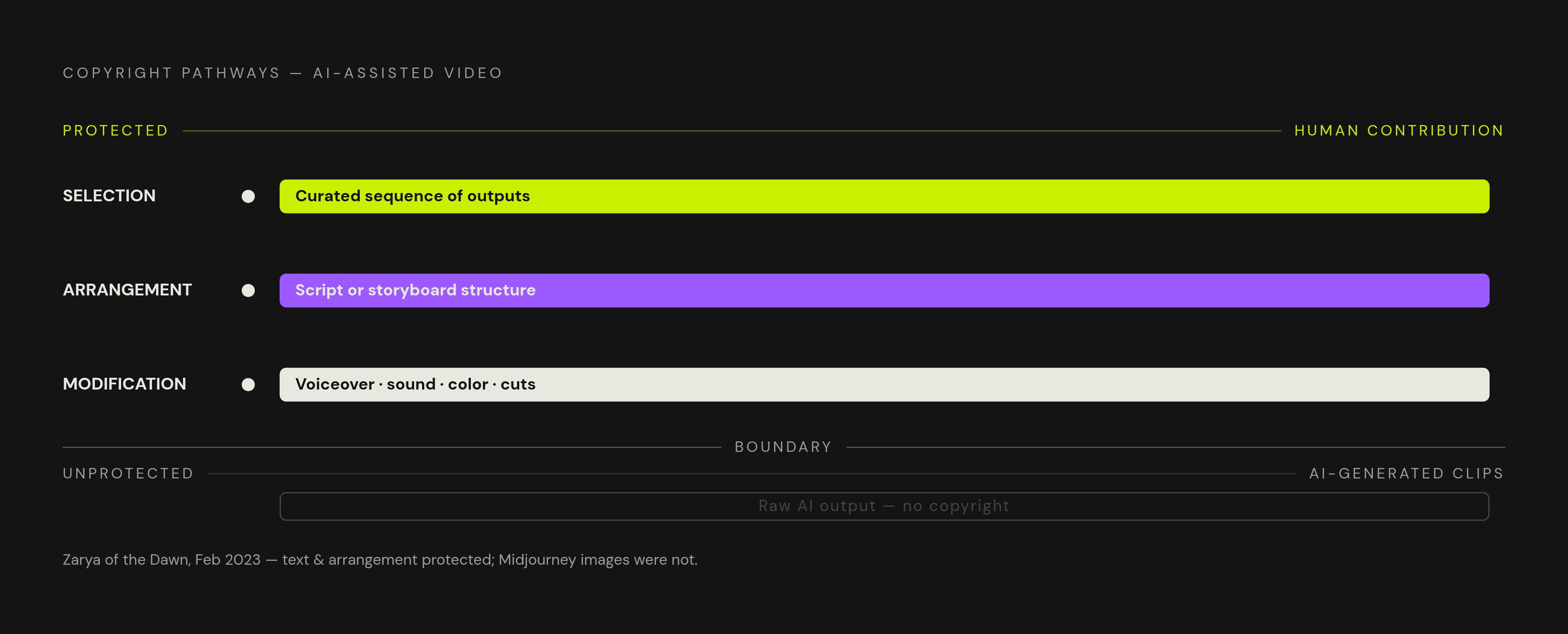
Once prompting is off the table as a path to protection, the Copyright Office's guidance points to three kinds of human contribution that can anchor a real copyright claim: selection, arrangement, and modification.
You choose meaningfully among many AI outputs; you don't just accept the first result. It covers curating across dozens of variations and making real editorial calls about what to keep and what to cut. The Office's guidance suggests a threshold of substance here: picking one clip out of two barely counts, but curating a large batch of generations down into a built sequence is the kind of judgment that starts to matter. A filmmaker who generates dozens of scene variations and then selects, discards, and sequences them to fit a narrative arc they designed is doing the kind of work this category protects.
Arrangement covers the structure placed around AI-generated pieces: a human-written script laid over AI visuals, or a storyboard that dictates how AI-generated shots get sequenced together. That structure can be protected even when none of the individual AI clips inside it are. The Zarya of the Dawn case put this into practice. Creator Kris Kashtanova's graphic novel kept copyright on its text and on the arrangement of its elements, but it lost protection on the individual Midjourney images, in a decision the Copyright Office issued in February 2023. That partial-protection outcome is now baked into how the Office handles every case that follows it.
Modification covers the creative edits layered on top of raw AI output: cuts, color grading, compositing, sound design, voiceover, and original scoring that reflect real human choices and show up visibly in the finished piece. But the Office has been clear that those edits have to go beyond minor touch-ups. In Zarya of the Dawn, the edits Kashtanova made to individual images were found either too small and unnoticeable, or too vaguely described, to supply the creativity needed for protection. So for video work, if you pair a human-recorded voiceover with deliberate editorial sequencing, or build original sound design around AI-generated visuals, you get a layer of protection the underlying clips don't have on their own.
Across all three categories, the protection covers only what the human did. No matter how you classify the finished work, the AI-generated pieces inside it stay unprotected. A video built from a dozen AI-generated clips, arranged and edited with real creative judgment, is protectable as that compilation. The clips themselves are not.
What the Zarya of the Dawn and A Collection of Objects Which Do Not Exist Registrations Reveal
Two registration decisions show what this framework looks like once it's applied to a real submission, and both land on the same partial-protection outcome: the human contribution gets protected, the AI-generated material does not, no matter how the finished piece gets packaged.
Kashtanova's graphic novel, Zarya of the Dawn, first got a full copyright registration. Then the Copyright Office took a closer look at how much of the work Midjourney had actually generated, and partially canceled it. The text survived, along with the selection, coordination, and arrangement of the written and visual elements. The individual Midjourney images did not, because the Office found they were not the product of human authorship. They came from text prompts, so the results were unpredictable and shaped by the model's training data, not by Kashtanova's direct creative control. The edits made to those images were too minor and too imperceptible to carry the creativity copyright requires. This decision, issued in February 2023, is the one that set the template every later guidance document has followed.
A Collection of Objects Which Do Not Exist, registered in January 2025, confirms the same pattern from a different angle. The Copyright Office registered the piece as a "collage, selection and arrangement," which protects the work as visual art, while the registration record specifically excluded the underlying "2-D artwork, images generated by artificial intelligence." You earn protection for the human act of selecting and arranging that AI-generated material. The material itself did not.
One pending case, Allen v. Perlmutter, is expected to test where this line falls when a creator combines iterative prompting with extensive post-processing. It remains unresolved, and whatever it settles isn't clear yet.
The practical consequence creators overlook: a platform license is not a copyright
The most expensive misunderstanding in AI video production is mixing up a commercial license with copyright ownership. A commercial license just gives you permission, under a platform's terms of service, to use the output you generated. Copyright is an exclusive legal right to control that work and stop others from using it. These are not the same thing, and confusing them creates a real gap: if a competitor generates and publishes the same or a near-identical AI clip, a license lets a creator keep using their own version, but without an actual copyright claim, there's no legal basis to stop anyone else from using theirs too.
Platform terms differ, so you need to know them before you build a production pipeline. Google Cloud's terms for Veo on Vertex AI state that generated output counts as Customer Data, that Google does not claim ownership over new intellectual property created in that output, and that it won't use customer data to train or fine-tune models without the customer's prior permission. That's a clear, favorable position, but it's also specific to that one platform and that one set of terms. If you mix tools like Veo and Kling into a single production, you can end up under mismatched terms without realizing it, unless you track those licensing details as part of the workflow.
Training-Data Liability and Digital Replica Rights
Whether you own copyright in an AI-generated video is a separate question from whether that video exposes you to infringement claims or likeness violations, and both risks are active and growing right now.
Training-data lawsuits show what courts are actually weighing. In Thomson Reuters v. Ross Intelligence, the Third Circuit affirmed in September 2026 that Westlaw's headnotes were original enough to be copyrighted, and that training an AI product on them without a license wasn't fair use. In Bartz v. Anthropic and Kadrey v. Meta, courts found that training AI models on copyrighted books counted as transformative use, even in Kadrey v. Meta, where some of the books had come from pirate shadow libraries, Anthropic still faced liability for how it obtained those pirated copies. The pattern across these rulings is consistent: acquiring source material lawfully and genuinely transforming it supports a fair-use defense, while building something that substitutes for the original market does not. For video specifically, Disney, NBCUniversal, and Warner Bros. Discovery filed suit in September 2025 against Hailuo AI, operated by MiniMax, claiming the platform profits from unlicensed use of "iconic copyrighted characters." So major entertainment IP holders are enforcing against AI video platforms now, and legal exposure can reach you even if your outputs only resemble protected characters and you never meant to copy anything specific.
A second regime, separate from copyright, covers digital replicas of real people. The NO FAKES Act of 2026, numbered S. 4591, advanced out of the US Senate Judiciary Committee by unanimous voice vote on June 18, 2026. It would create a new federal right letting any individual, famous or not, control how their voice and visual likeness get used in AI-generated replicas, and statutory damages would be set per violation. New York's Synthetic Performer Disclosure Law took effect on June 9, 2026, and it requires advertisers to label AI-generated human likenesses clearly. Because digital ad targeting doesn't respect state lines, that law reaches most national US ad campaigns, not just ones run out of New York. Both of these obligations apply whether or not the underlying video is copyrightable at all: an AI-generated likeness of a real person can be both legally unprotectable as anyone's intellectual property and a violation of that person's publicity rights at the same time.
Building an AI Video Workflow for Defensible Copyright
None of this means avoiding AI video tools. The most reliable place to start is before generation even happens, because copyright law looks for human creative contribution recorded at multiple points in the pipeline: writing a script, storyboard, or shot list by hand that governs what the AI is asked to produce sets the creative structure in place first and makes the human role in arranging the final piece easy to show later. From there, generating multiple variations and keeping a record of which ones got chosen and why turns ordinary curation into the kind of selection-based decision-making that can support a copyright claim, rather than just picking whatever the model spits out first. Layering original human work on top of the AI footage, things like a recorded voiceover, custom sound design, color grading, compositing, and deliberate editorial sequencing, builds a protectable layer that sits above the raw generated clips and stands on its own merits.
Keeping records of that process matters just as much as doing the work itself. Prompt logs, saved editing project files, scripts, storyboards, and dated notes documenting creative decisions all serve as evidence that a human was actually steering the work, and that evidence becomes critical if a copyright registration ever gets challenged or a dispute comes up over who has rights to the finished piece. So when you register AI-assisted work, you have to disclose and disclaim any material that was purely AI-generated, under Copyright Office guidance published in the Federal Register. The registration is valid only if that disclosure is made.
Before you publish anything built for a client or a paying campaign, two more checks matter. First, confirm that the platform's terms actually cover the intended use, since paid advertising, client delivery, and monetized content sometimes require a different tier of license than what a free or standard account provides. So if a client needs full IP ownership transferred to them, you usually can't just hand over raw AI output as owned property. Substantial human editing is what turns it into something that can actually change hands as intellectual property (and for high-value IP transfers, running the final agreement past legal counsel is worth the cost). Second, screen the finished video for anything that resembles a real, identifiable person or an existing copyrighted character before it goes out. New York's Synthetic Performer Disclosure Law, in effect since June 9, 2026, requires clear labeling of AI-generated human likenesses in advertising, and because ad targeting runs across state lines, that requirement reaches far beyond New York in practice. A clip that looks too close to a specific actor, a known character, or an existing film is a real legal exposure to catch before release, not after someone else catches it first.